
A palpable sense of apprehension has gripped global financial markets this week, as a significant geopolitical conflict in the Middle East has triggered a synchronized decline across major asset classes. Bitcoin (BTC), the flagship cryptocurrency, has experienced a notable downturn, shedding nearly 5% of its value. This pullback mirrors the broader weakness observed in traditional markets, with the S&P 500, Dow Jones Industrial Average, Nasdaq Composite, and even gold all registering losses. In stark contrast, crude oil has emerged as a surprising beneficiary, surging 7.30% and marking an impressive 53% increase since the escalation of hostilities between the United States and Iran, which began on February 28th.
This widespread market retreat underscores a discernible shift in capital allocation, as investors pivot away from riskier assets amidst escalating geopolitical uncertainties. The outflow of capital from prominent exchange-traded funds (ETFs) tracking the S&P 500 and the Nasdaq 100 provides compelling evidence of this risk-averse sentiment among traders.
Capital Exodus Across Major Investment Avenues
The magnitude of capital withdrawal from major equity indices is unprecedented in recent history. According to a report by The Kobeissi Letter, the S&P 500 (SPX) ETF and the Nasdaq 100 ETF (QQQ) have collectively witnessed outflows totaling $64 billion over the past three months. This represents the largest such outflow on record, starkly contrasting with the $50 billion inflow observed in November. These substantial withdrawals now account for approximately 5% of the total assets under management for these flagship ETFs, signaling a significant reassessment of equity market valuations and future prospects.

The impact of this broader market malaise has not spared the burgeoning spot Bitcoin ETF market. In the preceding two days, these newly established investment vehicles experienced outflows amounting to $253 million. While monthly ETF flows for cryptocurrencies remain in positive territory, standing at $1.48 billion, this figure must be contextualized against a backdrop of cumulative outflows totaling $6.3 billion between November and February. This historical data suggests that the current positive monthly inflow represents a fragile recovery in investor demand, susceptible to broader market sentiment shifts.
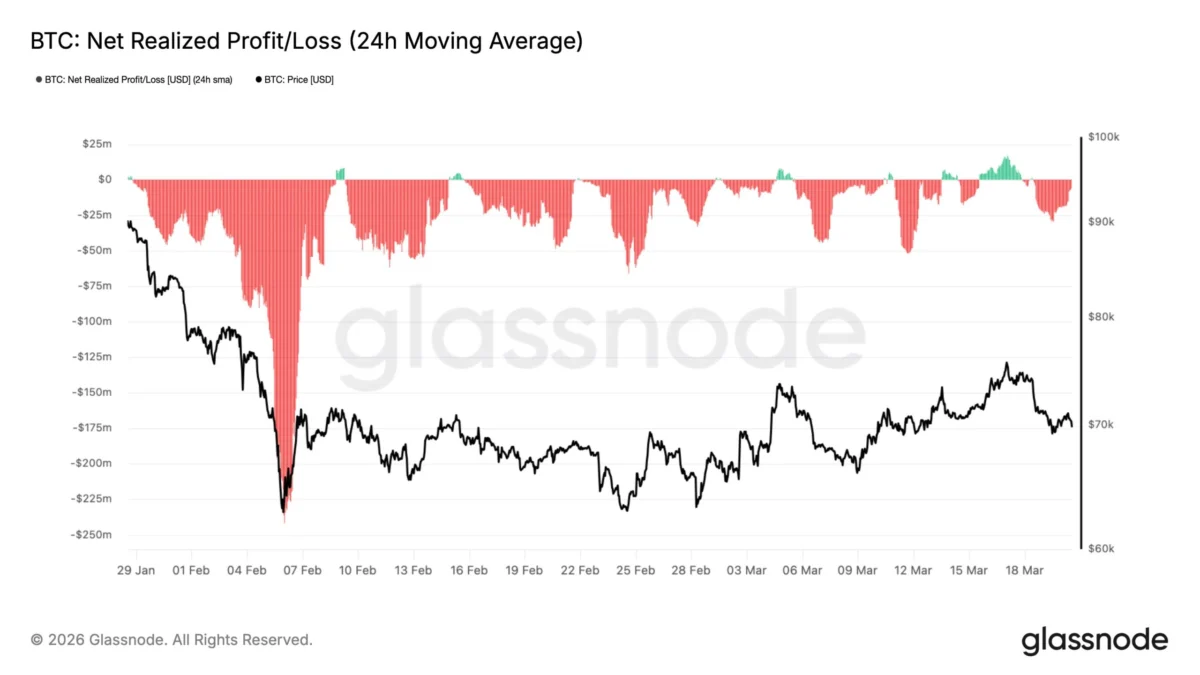
On-chain data further illuminates the challenges facing Bitcoin. Analysis from Glassnode indicates that the market is currently struggling to absorb the selling pressure. Net realized profit-taking, a metric that measures the profit realized by investors when they sell their Bitcoin, briefly accelerated to approximately $17 million per hour on a 24-hour average. However, this momentum proved unsustainable, leading to a subsequent price slip for Bitcoin below the critical $70,000 mark. Glassnode elaborated on this phenomenon, stating, "Broader geopolitical uncertainty appears to be compressing demand depth, limiting the market’s capacity to absorb even moderate realization events." This suggests that heightened global tensions are diminishing the market’s ability to absorb even modest selling pressure, creating a more volatile environment for Bitcoin.
War-Influenced Market Cycles and Historical Parallels
Market participants are actively drawing parallels between the current geopolitical climate and previous periods of global instability, particularly the Russia-Ukraine war in 2022. This historical lens provides a framework for understanding Bitcoin’s current price action and potential future trajectory.
Crypto commentator Carlitosway highlighted a striking coincidence: the escalation of the Russia-Ukraine conflict on February 24, 2022, occurred within a similar timeframe to the recent events in the Middle East. Following the initial invasion, Bitcoin experienced a brief sell-off, followed by a notable relief bounce of 24% in the subsequent four weeks. However, this upward momentum proved ephemeral, as Bitcoin subsequently entered a prolonged downturn, ultimately plummeting by an additional 64% by November 2022.

A similar pattern appears to be unfolding in the current market cycle. Following the commencement of the US and Israel-Iran conflict, Bitcoin initially saw a rally of nearly 10% last week. However, this upward momentum has since decelerated, mirroring the pattern observed in 2022. Carlitosway attributes this weakness to a confluence of factors, including sustained pressure on liquidity, rising energy costs, and the continuation of forced selling during periods of market stress. These dynamics collectively diminish the follow-through demand for Bitcoin, suggesting a prolonged stabilization phase may be on the horizon as capital rebuilds and selling pressure subsides.
The implications of this protracted stabilization phase are significant for investors. Crypto analyst Finish expressed a view that Bitcoin’s recovery path might not materialize until after a potential price bottom around the $55,000 level. This analyst further elaborated, "I frankly think that until the Iran war is settled, it’s gonna be hard for $BTC to rise. The environment is risk off, the SPX lost trillions in capitalisation, which leads me to a more neutral stance." This perspective underscores the direct correlation between geopolitical stability and the appetite for risk assets like Bitcoin.
The Interplay of Oil Prices and Geopolitical Risk
The dramatic surge in crude oil prices is intrinsically linked to the ongoing geopolitical tensions in the Middle East, a region vital for global energy supply. The conflict has disrupted supply chains and heightened fears of further escalation, leading to a premium being factored into oil prices. This rise in energy costs has a ripple effect across the global economy, impacting inflation, transportation costs, and ultimately, consumer spending.
The relationship between oil prices and Bitcoin has been a subject of increasing interest among analysts. Historically, periods of rising oil prices have sometimes coincided with increased inflation and a search for inflation hedges, which could theoretically benefit Bitcoin. However, in the current risk-off environment, the dominant narrative appears to be one of capital flight from speculative assets. The surge in oil prices, driven by fear and supply concerns, is acting as a drag on other markets, including Bitcoin, as investors prioritize safety and liquidity.

The potential for oil prices to reach unprecedented levels, such as $180 per barrel, as discussed in market analyses, would undoubtedly exacerbate economic pressures and further amplify geopolitical uncertainty. Such a scenario could lead to a more pronounced risk-off sentiment, potentially impacting Bitcoin’s ability to recover and even leading to further downside. Investors are closely monitoring the developments in the Middle East, recognizing that the trajectory of the conflict will play a pivotal role in shaping the broader economic landscape and asset performance.
Broader Economic Implications and Investor Sentiment
The coordinated market weakness extending beyond cryptocurrencies to traditional asset classes highlights the interconnectedness of the global financial system and the profound impact of geopolitical events. The significant outflows from major ETFs signal a broader investor recalibration, moving away from growth-oriented investments towards safer havens. This sentiment shift is driven by a combination of factors, including the immediate threat of escalating conflict, the potential for prolonged economic disruption, and the uncertainty surrounding future monetary policy.
The sustained pressure on liquidity, coupled with rising energy costs, creates a challenging environment for asset appreciation. For Bitcoin, this translates into a subdued demand environment, where even moderate selling pressure can lead to significant price corrections. The narrative of Bitcoin as a potential inflation hedge or a store of value is being tested in this high-stakes geopolitical climate, where immediate safety concerns are taking precedence.
The coming weeks will be crucial in determining the short-term direction of global markets. The de-escalation or further intensification of the conflict in the Middle East will significantly influence investor sentiment and capital flows. Market participants will be closely observing official statements from involved nations, diplomatic efforts, and the impact on energy markets. The resilience of Bitcoin and other risk assets will ultimately depend on the resolution of these geopolitical uncertainties and the subsequent stabilization of the global economic outlook. The current market behavior serves as a stark reminder of the inherent volatility and interconnectedness that characterize modern financial markets, particularly in the face of significant global events.

