
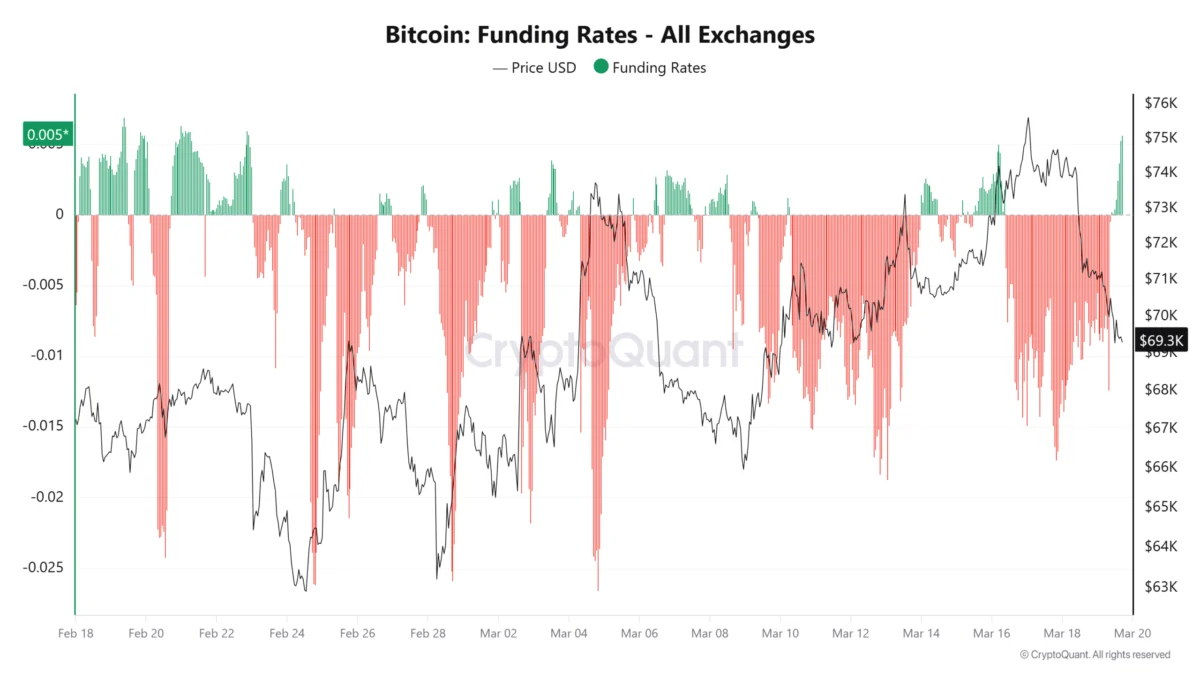
Bitcoin (BTC) experienced a notable downturn on Thursday, falling below the significant $69,000 mark. This retreat brings the cryptocurrency back within a six-week trading range, a stark contrast to its recent surge above $76,000 just days prior. The current pullback appears to be influenced by an increase in selling pressure within Bitcoin futures markets and a discernible slowdown in demand from investors based in the United States. Despite this immediate bearish sentiment, analysts suggest that the potential for a rebound rally remains, contingent on specific technical conditions aligning. A recurring chart pattern offers a glimmer of hope for a return to Bitcoin’s bullish trajectory.
Bitcoin Futures Take Center Stage as Spot Demand Falters
The recent price correction in Bitcoin is directly correlated with a tangible shift in market dynamics, where the influence of derivatives trading has begun to outweigh that of spot market activity. Evidence of this trend is visible in the Coinbase premium gap, which has turned negative following a period of consistent demand. This negative premium is a strong indicator of waning follow-through from US-based investors, suggesting a cooling of enthusiasm or a strategic retreat from this key demographic.
Further substantiating this observation, crypto analyst IT Tech highlighted a significant imbalance between the spot and perpetual futures markets. The cumulative volume delta (CVD), a metric designed to track the net buying versus selling pressure across various markets, revealed a $40.64 million decline in spot CVD. More alarmingly, the perpetual CVD saw a substantial drop of $506.75 million. This stark contrast underscores a considerably stronger selling pressure emanating from leveraged traders in the derivatives space.
While the selling pressure from leveraged traders is a concern, an examination of Bitcoin’s funding rates offers a nuanced perspective. These rates have recently flipped to a positive 0.05%, indicating a shift where holders of long positions are now paying those with short positions. This suggests a prevailing long bias within the broader derivatives market, even amidst the observed selling. Order book data further supports this by showing robust bid-side support holding firm near the $70,000 region, with both spot and perpetual markets exhibiting a leaning towards buyers at these levels.

A Recurring Fractal Pattern Hints at Potential Reversal
On lower timeframes, Bitcoin is exhibiting a chart pattern that bears a striking resemblance to the market behavior observed between March 6 and March 8. During that period, Bitcoin experienced a correction, where the price declined, swept through internal liquidity levels, and subsequently reversed to a higher trajectory. The current price action is mirroring this sequence, with successive lower lows forming, which could signal a potential exhaustion phase for the prevailing downward momentum.
In the March instance, the eventual reversal was strongly correlated with a bullish divergence on the Relative Strength Index (RSI) indicator. This divergence occurred when the RSI maintained equal lows while the price itself printed a lower low, a classic signal of weakening selling momentum. A comparable divergence is now developing in the current market, reinforcing the bullish interpretation of this fractal structure.
The liquidation data further bolsters this bullish fractal setup. On both occasions, significant long-side liquidations were observed. These liquidations effectively reduce open interest and flush out overleveraged positions, which can often precede a price rebound. The $70,000 level appears to be a critical juncture. A swift reclaim of this price point, mirroring the recovery path seen in March, could pave the way for a renewed ascent towards the $76,000 mark.
The $72,000 level is identified as a key pivot point. A successful reassertion of this level could potentially trigger a short squeeze, trapping traders who have bet against the cryptocurrency and forcing them to buy back in, further fueling upward momentum.
However, the viability of this bullish fractal setup is time-sensitive. A decisive breakdown below the $68,300 support level would invalidate the pattern and shift the market’s focus towards lower support levels. In such a scenario, the $65,000 and $62,000 price points, which represent significant liquidity zones on higher timeframes, would become the next potential targets.

Ryan Scott, founder of Trading Stables, has identified $73,000 as a crucial base level. He has cautioned that a failure to stabilize above this level would indicate a weak buyer response, thereby increasing the likelihood of a descent towards the lower range lows, potentially around $62,000. This sentiment from a prominent market observer adds weight to the significance of these price levels.
Broader Market Context and Investor Sentiment
The current price action in Bitcoin unfolds against a backdrop of mixed signals within the broader cryptocurrency market. While institutional interest in Bitcoin ETFs has remained a significant driver of capital inflows, recent data suggests a potential cooling in the pace of these investments. The United States, historically a dominant force in Bitcoin adoption and investment, appears to be experiencing a temporary lull in demand, as indicated by the Coinbase premium gap.
The recent surge in Bitcoin’s price, pushing it to all-time highs earlier in the year, was fueled by a confluence of factors including the approval of spot Bitcoin ETFs in the US, the upcoming Bitcoin halving event, and a general increase in retail investor participation. However, the current pullback suggests that the market is undergoing a period of consolidation and re-evaluation, with derivatives traders playing a more pronounced role in dictating short-term price movements.
The halving event, a pre-programmed reduction in the rate at which new Bitcoins are created, is historically associated with price increases due to a decrease in supply. While this event is still anticipated, its immediate impact on price might be tempered by prevailing market sentiment and the influence of leveraged trading.
Implications for the Cryptocurrency Ecosystem
The current market dynamics have several implications for the wider cryptocurrency ecosystem. The increased dominance of futures trading could lead to greater price volatility, as leveraged positions are more susceptible to rapid liquidation. This could create a more challenging environment for risk-averse investors.

Conversely, the observed selling pressure from leveraged traders, if it subsides, could pave the way for a more sustainable price increase, driven by genuine spot demand. The resilience of the $70,000 support level will be a key determinant in whether Bitcoin can maintain its bullish momentum or succumb to further downward pressure.
The development of native DeFi solutions on Bitcoin, such as the recently launched OP_NET, could also play a role in shaping future market dynamics. By enabling decentralized finance applications directly on the Bitcoin blockchain without the need for bridges or wrapped tokens, these innovations aim to unlock new use cases and attract a different segment of investors, potentially diversifying demand drivers beyond traditional trading.
The performance of Bitcoin often acts as a bellwether for the entire cryptocurrency market. A sustained recovery above key resistance levels would likely instill confidence and encourage investment across a broader range of digital assets. Conversely, a prolonged downturn could lead to a broader market correction, impacting altcoins more significantly.
Expert Opinions and Forward-Looking Statements
Market analysts are closely monitoring the interplay between futures and spot markets, as well as the evolving investor sentiment. While the immediate outlook presents challenges, the recurring fractal pattern and the positive funding rates suggest that a recovery is plausible. However, the time-sensitive nature of these technical indicators underscores the need for caution and strategic positioning.
The narrative surrounding Bitcoin’s future price trajectory remains a subject of intense debate. While some market participants are optimistic about a sustained bull run, others are expressing concerns about potential corrections. Notably, Bitcoin prediction markets have indicated a 70% chance of BTC price crashing to $55,000 in 2026. Such forecasts, while speculative, highlight the inherent volatility and uncertainty within the cryptocurrency landscape.

The ability of Bitcoin to navigate these short-term headwinds and reclaim higher price levels will ultimately depend on a combination of technical factors, macroeconomic influences, and the sustained interest of both retail and institutional investors. The coming days and weeks will be crucial in determining whether the current pullback is a temporary pause or the beginning of a more significant correction.
This article does not contain investment advice or recommendations. Every investment and trading move involves risk, and readers should conduct their own research when making a decision. While we strive to provide accurate and timely information, Cointelegraph does not guarantee the accuracy, completeness, or reliability of any information in this article. This article may contain forward-looking statements that are subject to risks and uncertainties. Cointelegraph will not be liable for any loss or damage arising from your reliance on this information.

