
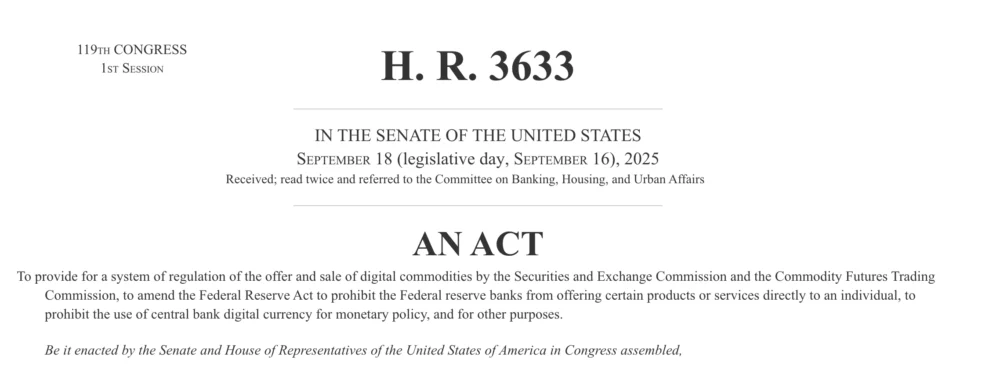
The recently proposed US Digital Asset Market Structure Clarity Act, or CLARITY Act, is drawing significant scrutiny from within the cryptocurrency industry, with prominent figures warning that its current structure could inadvertently empower traditional financial institutions and undermine the decentralized ethos of blockchain technology. Dr. Friederike Ernst, co-founder of the Gnosis blockchain protocol, has voiced strong concerns, arguing that the bill’s foundational assumptions risk a significant rollback of user ownership and control in the digital asset space.
At the heart of Ernst’s critique lies the CLARITY Act’s apparent reliance on centralized intermediaries for digital asset activities. According to Ernst, the regulatory framework presupposes that transactions and operations must flow through established financial gatekeepers. This approach, she contends, could lead to the consolidation of the burgeoning crypto ecosystem into the hands of a few dominant players, mirroring the very structures the blockchain revolution sought to disrupt.
"Blockchain’s real breakthrough was not just a new financial infrastructure," Dr. Ernst stated in an interview with Cointelegraph. "It was the ability for users themselves to become owners of the networks they rely on. If activity is pushed back through institutional intermediaries, users risk becoming customers renting access to financial technology once again rather than stakeholders in it. The challenge is ensuring regulatory clarity does not unintentionally undermine that ownership model."
This perspective highlights a core tension in the ongoing debate surrounding digital asset regulation. Proponents of the CLARITY Act often emphasize the need for clear jurisdictional boundaries between regulatory bodies like the Securities and Exchange Commission (SEC) and the Commodity Futures Trading Commission (CFTC), as well as the importance of consumer protection. Ernst acknowledges that the bill does offer some positive steps in this direction, including clarifying regulatory oversight and providing protections for peer-to-peer transactions and self-custody. However, she maintains that these benefits are overshadowed by the bill’s potential to stifle innovation and reintroduce systemic risks inherent in the legacy financial system.
The CLARITY Act’s failure to adequately safeguard open, permissionless blockchain rails and decentralized finance (DeFi) protocols, Ernst argues, could lead to the replication of the traditional financial system’s vulnerabilities within the digital asset landscape. This includes concerns about single points of failure, lack of transparency, and the potential for market manipulation.
The CLARITY Act: A Stalled Legislative Journey and Industry Divisions
The legislative journey of the CLARITY Act has been far from smooth, marked by significant disagreements between the cryptocurrency industry, traditional banking entities, and even within the crypto community itself. A key point of contention that has stalled the bill’s progress in Congress revolves around the issue of stablecoin yields. Specifically, there is debate over whether stablecoin issuers should be permitted to share interest earned on their reserves with stablecoin holders.

This particular provision has become a flashpoint, revealing divergent interests and priorities. For many in the crypto space, the ability for stablecoin issuers to offer yield is seen as a crucial incentive for adoption and a natural extension of the financial innovation promised by digital assets. Conversely, traditional financial institutions and some regulators may view this as a potentially risky practice that could blur the lines between stablecoins and traditional deposit-taking activities, necessitating stricter oversight.
The impact of these disagreements was starkly illustrated in January when Coinbase, one of the largest cryptocurrency exchanges in the United States, announced it was withdrawing its support for the CLARITY Act. In a statement, Coinbase CEO Brian Armstrong cited profound concerns over provisions that he believed would weaken the decentralized finance industry, prohibit stablecoin yield, and hinder the growth of the tokenized real-world asset sector. Armstrong’s sentiment, encapsulated in his X post stating, "We’d rather have no bill than a bad bill," underscores the high stakes involved and the industry’s willingness to oppose legislation perceived as detrimental to its core principles.
The CLARITY Act’s legislative status is currently uncertain. While some lawmakers have expressed optimism about its potential passage. US Senator Bernie Moreno, for instance, indicated in early April that he believed the bill could pass by April and reach President Donald Trump’s desk for signing. However, the timeline for legislative action in the US Congress is notoriously fluid.
Adding to the uncertainty, Alex Thorn, head of firmwide research at investment firm Galaxy, cautioned that if the bill does not clear Congress by April 2026, its chances of becoming law in the current election year are "extremely low." Thorn further suggested that the debate over stablecoin yields might be a symptom of deeper, unresolved issues within the bill, including potential challenges related to DeFi, protections for developers, and the precise allocation of regulatory authority. "It’s very possible that rewards are not the ‘final’ hurdle but instead just the current hill the bill is dying on," Thorn commented on X, highlighting the multifaceted nature of the legislative deadlock.
Underlying Principles and Potential Implications
The debate surrounding the CLARITY Act is not merely a procedural wrangle over specific clauses; it represents a fundamental philosophical divergence on how digital assets should be integrated into the broader financial ecosystem. The core of the cryptocurrency movement has always been about disintermediation, empowering individuals with greater control over their finances, and fostering open, permissionless networks.
Dr. Ernst’s assertion that the bill risks transforming users from network owners into mere renters of financial technology touches upon a critical aspect of blockchain’s value proposition. In a truly decentralized system, users contribute to and benefit from the network’s growth and security. Introducing intermediaries that capture value and control access can erode this dynamic, potentially leading to:
- Increased Fees and Reduced Efficiency: Centralized intermediaries often introduce transaction fees and operational overhead, which can negate some of the cost-saving advantages of blockchain technology.
- Censorship and Control: If a few large institutions control the primary channels for digital asset activity, they gain the power to censor transactions or restrict access based on their own policies or external pressures.
- Stifled Innovation: The imposition of legacy financial structures could discourage the development of novel DeFi applications and business models that thrive on open, permissionless environments.
- Reintroduction of Systemic Risk: The collapse of traditional financial institutions has often sent shockwaves through the global economy. If crypto’s infrastructure becomes heavily reliant on a few large players, it could become susceptible to similar systemic risks.
Conversely, proponents of the CLARITY Act, and indeed many traditional financial institutions, argue that regulation is essential for maturing the digital asset market, ensuring stability, and preventing illicit activities. They contend that the decentralized nature of some crypto projects makes them inherently risky and that a degree of centralization is necessary for effective oversight and consumer protection. The challenge, therefore, lies in finding a regulatory balance that fosters innovation while mitigating risks.

The CLARITY Act, in its current form, appears to be an attempt to bridge this gap. However, the criticism from figures like Dr. Ernst suggests that the proposed bridge may be leaning too heavily towards the traditional side, potentially sacrificing the unique benefits of decentralized finance in the process.
Broader Context and Future Outlook
The discussion around the CLARITY Act occurs within a broader global context of evolving digital asset regulation. Jurisdictions worldwide are grappling with how to categorize, oversee, and integrate cryptocurrencies and blockchain technology into their existing financial frameworks. The United States, as a major global financial hub, plays a significant role in shaping these trends.
The outcome of the CLARITY Act’s legislative process will have far-reaching implications, not only for the US digital asset market but potentially for the global trajectory of crypto regulation. If the bill passes in its current form, it could set a precedent for other nations to adopt similar intermediary-centric regulatory models. Conversely, if it fails or is significantly amended, it could signal a continued openness to more decentralized and innovation-friendly approaches.
The involvement of former officials, such as former CFTC Chairman J. Christopher Giancarlo, in advocating for regulatory clarity for banks dealing with crypto, further underscores the complex interplay between established financial players and the emerging digital asset industry. Giancarlo has often emphasized that clarity is paramount for traditional finance to engage with digital assets, suggesting that a well-defined regulatory environment, even if it imposes certain structures, is preferable to the current ambiguity.
However, the concerns raised by industry participants like Dr. Ernst and Coinbase highlight the need for a nuanced approach. The goal of regulation should be to protect investors and ensure financial stability without extinguishing the revolutionary potential of decentralized technologies. The CLARITY Act, as it stands, appears to be a focal point for this ongoing debate, and its future will be closely watched by innovators, investors, and regulators alike.
The coming months will be critical in determining the fate of the CLARITY Act. The disagreements over stablecoin yields, DeFi protections, and developer liability represent significant hurdles. Whether these can be overcome through compromise and amendment, or whether the bill will ultimately fail to gain sufficient traction, remains to be seen. The outcome will undoubtedly shape the future landscape of digital assets in the United States and provide valuable lessons for regulatory efforts worldwide.

