

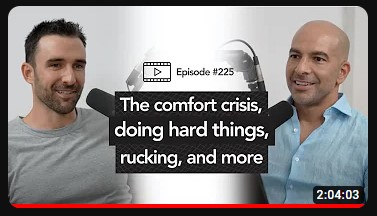
The concept of "The Comfort Crisis," initially popularized through a dialogue between Dr. Peter Attia and author Michael Easter, has rapidly gained traction as a critical lens through which to examine the challenges facing contemporary society. Far from a mere lifestyle trend, this perspective posits that an unprecedented level of ease and indulgence, rather than overt hardship, is paradoxically undermining human health, resilience, and overall contentment. It suggests that many of the pervasive issues in developed nations—from chronic health conditions and mental health struggles to societal ennui and escalating consumer debt—stem not from scarcity, but from an overabundance of convenience and a systemic avoidance of discomfort.
The Genesis of a Groundbreaking Concept

Michael Easter, a former writer for Men’s Health magazine, brings a unique perspective to this discussion. His personal battle with alcohol addiction, a struggle he notes has echoed through generations of his family, provided a profound understanding of the seductive nature of hollow comforts and the critical importance of confronting adversity. This lived experience, coupled with extensive research, culminated in his seminal work, "The Comfort Crisis: How Our Modern Search for Ease is Making Us Soft, Sick, and Unhappy—and What You Can Do About It." The book, and its subsequent discussion on influential platforms like Dr. Peter Attia’s "The Drive" podcast, served to amplify this urgent message, resonating with a public increasingly aware of the subtle erosion of well-being despite material prosperity.
Easter’s narrative interweaves a rigorous scientific exploration of human psychology and physiology with a gripping account of an incredibly demanding caribou hunting expedition in the remote Alaskan wilderness. This dual approach allows readers to grasp complex scientific principles through the visceral experience of purposeful hardship, illustrating how direct engagement with challenging environments can reset our baseline for comfort and re-sensitize us to genuine satisfaction.
Redefining Societal Problems: Beyond Scarcity to Satiety

For decades, public discourse has largely focused on addressing perceived crises of debt, healthcare access, and economic hardship. However, proponents of the "Comfort Crisis" theory argue that this focus often misses a more fundamental underlying issue. In affluent societies, particularly in nations like the United States, the dominant problem may not be a lack of resources or opportunity, but rather an overwhelming ease of existence that has detached individuals from the natural rhythms of challenge, effort, and genuine achievement. This overindulgence, often unrecognized, is presented as a primary driver of widespread malaise and systemic health issues.
Statistics paint a stark picture: The World Health Organization (WHO) reports that physical inactivity is a leading risk factor for non-communicable diseases (NCDs) such as heart disease, stroke, diabetes, and certain cancers. Globally, over a quarter of adults are not meeting recommended levels of physical activity. In the United States, data from the Centers for Disease Control and Prevention (CDC) indicates that more than 40% of adults are obese, a condition intrinsically linked to sedentary lifestyles and readily available, calorie-dense foods. These figures underscore a societal drift towards minimal physical exertion and readily accessible comforts, contributing to a significant public health burden.
The "Problem-Seeking" Brain: A Peril of Perpetual Ease
One of the most profound insights from "The Comfort Crisis" is its exploration of the human brain’s inherent tendency to scan its environment for problems, irrespective of the actual level of safety or perfection. Scientific studies cited in Easter’s work demonstrate that as external threats diminish, the human mind doesn’t simply relax into contentment; instead, it lowers its threshold for what constitutes a "problem." Researchers have shown that in environments progressively stripped of objective dangers, individuals unconsciously begin to perceive a wider range of stimuli as problematic, even if these issues are trivial by any objective measure.
This psychological phenomenon has profound societal implications. In increasingly comfortable environments, minor inconveniences can escalate into perceived crises. This psychological vulnerability can manifest in disproportionate complaints about trivial matters, fostering an environment ripe for political exploitation. Politicians, finely attuned to public sentiment, can capitalize on these manufactured grievances, crafting policies or "wedge issues" that further divide communities over concerns that might otherwise be non-existent in a more resilient populace. The genuine strength of a society, then, may lie in its collective ability to discern substantive challenges from self-generated anxieties, rather than succumbing to the temptation to bicker over insubstantial concerns.
Conversely, individuals who endure genuinely harsh environments often exhibit remarkable resilience and a reduced propensity for complaint. The article references observations of Ukrainian citizens living in war-torn regions, who, despite immense danger, often reported feeling "safe" in their immediate surroundings at rates not dissimilar to those in much more secure nations. This adaptive capacity highlights how regular exposure to genuine adversity can recalibrate one’s perception of normalcy and cultivate a profound appreciation for fundamental safety and well-being. This principle also helps explain why first-generation immigrants, accustomed to greater hardship, frequently demonstrate exceptional drive in building businesses and wealth, while subsequent generations, raised in comfort, may be more prone to complacency.

The Healing Power of Nature and the Effort-Reward Dynamic
Beyond psychological recalibration, "The Comfort Crisis" underscores the profound benefits of reconnecting with nature. Modern urbanized living, characterized by cubicles and vehicular commutes, has increasingly isolated individuals from natural environments. However, a growing body of scientific evidence supports the therapeutic power of nature exposure. Research into practices like shinrin-yoku (forest bathing) in Japan demonstrates measurable physiological benefits, including reduced cortisol levels, lowered blood pressure, improved immune function, and enhanced mood. Even the simple act of placing a plant in a hospital room has been shown to accelerate patient recovery, highlighting a deep biological imperative for connection with the natural world. Prolonged immersion in a living forest, therefore, acts as a potent, easily accessible form of medicine, counteracting the detrimental effects of artificial environments.
Furthermore, the book delves into the human adaptation toward the ratio of effort to reward, asserting a fundamental truth: "It’s proven the harder you work for something, the happier you’ll be about it." This principle is often undermined in an age of instant gratification and effortless consumption. The easy availability of goods and services, while seemingly beneficial, can decouple effort from reward, diminishing the sense of accomplishment and satisfaction derived from overcoming challenges.

This inherent aversion to physical exertion is a striking feature of modern human behavior. A compelling statistic cited illustrates this point: a mere 2% of people opt to take the stairs when an escalator is also available. This seemingly innocuous preference for ease comes at an "insane cost" to public health. Regular physical activity, even moderate amounts, is demonstrably linked to a reduced probability and severity of a vast array of diseases, bolstering both physical and mental well-being. The profound benefits of daily outdoor activity, heavy exertion, and minimizing sedentary behavior are not speculative "alternative medicines" but rather scientifically validated cornerstones of human health.
Broader Impact and Policy Implications
The implications of the "Comfort Crisis" extend beyond individual health to broader societal structures. A populace increasingly averse to discomfort and challenge may struggle with adaptability, problem-solving, and innovation. The economic costs are also substantial, with healthcare systems straining under the burden of preventable chronic diseases fueled by sedentary lifestyles and poor dietary choices. According to the CDC, chronic diseases are responsible for 7 of 10 deaths each year and account for 86% of the nation’s healthcare costs.

The concept calls into question the prevailing medical model, which often focuses on treating symptoms with exotic medications and specialized treatments, sometimes overlooking fundamental lifestyle interventions. While not advocating for the abandonment of professional medical advice, the "Comfort Crisis" framework suggests a re-prioritization: addressing basic human needs for movement, outdoor exposure, and meaningful challenge should be the initial, foundational step in promoting health. Only after these "minimum basic things for human survival" are met should more complex and niche medical interventions be considered the primary course of action.
Purposeful Hardship vs. Purposeful Spending
Within communities focused on financial independence (FIRE), discussions often revolve around "purposeful spending" – allocating resources to experiences and items that genuinely enhance life. However, the "Comfort Crisis" introduces a crucial counterpoint: the danger of inadvertently spending money to eliminate all forms of productive discomfort. While investing in quality tools, educational experiences, and generosity towards others is lauded, there’s a subtle trap in constantly seeking to make life "easier and easier."

The central lesson is to cultivate an awareness of this tendency and to deliberately integrate challenge into daily life, even amidst increasing affluence. The maxim "buy yourself better tools, not softer chairs" encapsulates this philosophy, advocating for investments that empower agency and capability rather than merely promoting passive comfort. This reframing suggests that true enrichment and resilience stem not from the absence of difficulty, but from the conscious choice to engage with and overcome it, recognizing that the "hard and uncomfortable" elements are often the most potent catalysts for growth and well-being.
In conclusion, "The Comfort Crisis" offers a compelling and often counter-intuitive explanation for many of the modern world’s ailments. By challenging the ingrained belief that comfort is synonymous with happiness and progress, it encourages a fundamental re-evaluation of our lifestyles, priorities, and societal values. Embracing purposeful hardship, reconnecting with nature, and understanding our innate drive to seek problems can pave the way for a more resilient, healthier, and genuinely fulfilled existence, both individually and collectively.

