
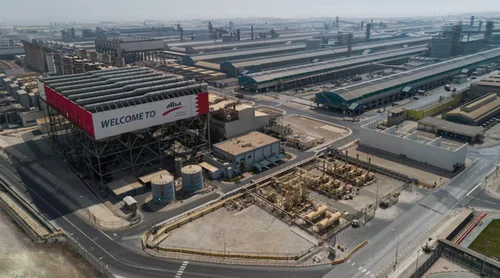
The world’s largest single-site aluminium smelter, Aluminium Bahrain (Alba), announced a significant reduction in its output by approximately 20% on Sunday, marking a concerning escalation of geopolitical tensions impacting global industrial supply chains. This pivotal decision by the Middle Eastern industrial giant highlights how disruptions in the critical Strait of Hormuz are no longer solely an energy-centric issue but are now directly threatening the availability and pricing of essential industrial metals. The ripple effects of this development are poised to disrupt global manufacturing and logistics, potentially leading to increased aluminium prices on international markets.
Alba’s Strategic Cutback and Its Global Ramifications
Aluminium Bahrain (Alba), a cornerstone of Bahrain’s industrial landscape and a key player in the global aluminium sector, initiated a controlled and safe shutdown of three of its reduction lines on Sunday. This proactive measure, as reported by Bloomberg, is designed to preserve business continuity in the face of severely disrupted maritime shipping routes traversing the Strait of Hormuz. The strait, a narrow chokepoint between the Arabian Peninsula and Iran, has become a focal point of regional instability, impeding the free flow of international commerce.
The 20% production cut at Alba translates to a suspension of output equivalent to approximately 19% of the company’s total annual capacity of 1.62 million tons. Critically, this reduction alone accounts for roughly 2.2% of the world’s total aluminium production. The primary motivation behind this drastic step is to safeguard Alba’s existing inventory of crucial raw materials, which are now facing considerable delays and uncertainty in transit through the volatile maritime corridor. This decision underscores the profound logistical challenges that have emerged, forcing even the largest industrial operations to adapt to an increasingly unpredictable global supply chain environment.
The Strait of Hormuz: A Vital Chokepoint Under Pressure
The Strait of Hormuz is one of the world’s most strategically important maritime passages, connecting the Persian Gulf with the Arabian Sea and the broader Indian Ocean. It is a conduit for a significant portion of global seaborne oil and liquefied natural gas (LNG) traffic, making it a constant subject of international attention. However, recent escalations in regional conflicts, particularly those stemming from the Red Sea region and involving various non-state actors, have extended their shadow over the Strait, leading to increased security concerns and shipping disruptions.
Historically, the Strait has witnessed periods of tension, but the current environment is characterized by a sustained level of risk that shipping companies and insurers are finding increasingly difficult to mitigate. While much of the initial focus of these disruptions centered on energy commodities, the Alba announcement signals a critical shift, indicating that the impact is now broadening to encompass a wider array of industrial goods and raw materials. This expansion of affected sectors points to a deeper and more pervasive challenge to global trade.
Shipping data from the Hormuz chokepoint corroborates the muted traffic, showing tankers anchored on both sides of the strait’s entry and exit points, a clear indicator of hesitation and caution among maritime operators. This hesitancy translates directly into delays, increased shipping costs, and, as demonstrated by Alba, direct production curtailments for industries dependent on these routes.
The Broader Landscape of Aluminium Production in the Gulf
The Gulf Cooperation Council (GCC) member states collectively represent a significant force in the global aluminium market. In 2025, these nations produced an estimated 6.16 million tons of aluminium, according to data from the International Aluminium Institute (IAI). This figure accounts for approximately 8.35% of the global supply, underscoring the region’s vital role in meeting international demand for the lightweight and versatile metal.
Alba itself is a cornerstone of this regional industry, having grown into a global leader since its inception in 1971. Its operations are highly integrated, relying on a consistent supply of alumina (the primary raw material for aluminium production) and robust logistics to export its finished products. The current disruptions pose a direct threat not only to Alba but also to the stability of the entire GCC aluminium sector, which includes other major players like Emirates Global Aluminium (EGA) in the UAE and Ma’aden in Saudi Arabia. Should these disruptions persist or intensify, the potential for broader production cuts across the region could have a far more profound impact on global supply.
Aluminium’s Critical Role in Modern Industry
Aluminium is not merely an industrial commodity; it is a foundational material for numerous critical sectors of the global economy. Its unique properties—lightweight, corrosion-resistant, highly conductive, and infinitely recyclable—make it indispensable.

- Automotive Industry: Aluminium is crucial for lightweighting vehicles, improving fuel efficiency, and reducing emissions. A disruption in supply can impact car production lines worldwide.
- Aerospace: From aircraft fuselages to engine components, aluminium alloys are vital for aviation safety and performance.
- Construction: Used in structural components, window frames, roofing, and cladding, aluminium is a staple in modern architecture and infrastructure development.
- Packaging: Its barrier properties and recyclability make it ideal for beverage cans, food containers, and pharmaceutical packaging.
- Electronics: Aluminium is used in heat sinks, casings for consumer electronics, and electrical transmission lines.
- Renewable Energy: It plays a role in solar panel frames and wind turbine components.
Any significant tightening of aluminium availability or a sustained increase in its price can therefore have cascading effects across these diverse industries, potentially leading to higher manufacturing costs, delayed product launches, and ultimately, increased consumer prices.
Chronology of Escalation and Responses
The current crisis in the Strait of Hormuz is an extension of broader geopolitical tensions that have been simmering and escalating in the Middle East.
- October 2023 onwards: The conflict in Gaza intensifies, leading to increased regional instability.
- November 2023: Houthi rebels in Yemen begin attacking commercial shipping in the Red Sea, claiming solidarity with Palestinians and targeting vessels linked to Israel or the US. This forces many shipping companies to reroute vessels around the Cape of Good Hope, significantly increasing transit times and costs.
- December 2023 – January 2024: International naval forces, primarily led by the US and UK, establish Operation Prosperity Guardian to protect Red Sea shipping, but attacks persist. The economic fallout, including increased insurance premiums and logistical delays, becomes widely apparent.
- February – March 2024: Concerns mount that the Red Sea disruptions could spill over or be mirrored in other strategic chokepoints, including the Strait of Hormuz, especially given Iran’s influence in the region and its stated stance against certain maritime activities.
- March 16, 2024 (Saturday): Iranian Foreign Minister Abbas Araghchi publicly states that the Hormuz waterway remains open to all vessels, except those linked to the US or Israel. This statement, while attempting to reassure, simultaneously introduces a new layer of political risk and selective targeting.
- March 17, 2024 (Sunday): Aluminium Bahrain (Alba) announces its decision to cut production by 20%, directly attributing the move to the heavily disrupted maritime shipping routes through the Hormuz chokepoint. This is a tangible manifestation of the "spreading into industrial metals" warned by analysts.
This timeline illustrates a clear progression from regional conflict to direct economic consequences on global supply chains, moving from energy commodities to fundamental industrial materials.
Market Reactions and Price Pressures
The announcement from Alba, combined with the ongoing risks to the broader aluminium market in the Gulf, is expected to exert upward pressure on aluminium prices on the London Metal Exchange (LME). Even before Alba’s announcement, aluminium prices had shown sensitivity to geopolitical events and energy price fluctuations, given the energy-intensive nature of aluminium smelting.
Commodity analysts are closely monitoring the situation, anticipating that a sustained reduction in supply from a major producer like Alba, coupled with the increased costs and uncertainties of transportation, will inevitably lead to higher spot and futures prices. This could exacerbate inflationary pressures globally, as the cost of raw materials feeds into the production costs of countless consumer and industrial goods. The LME aluminium price chart reflects this underlying tension, with any news of supply disruption or geopolitical instability often triggering immediate market responses.
Implications for Bahrain and the Global Economy
For Bahrain, Alba is a national champion and a significant contributor to the country’s economy, providing employment and export revenue. A prolonged production cut could have domestic economic ramifications, even if the company emphasizes business continuity. The government of Bahrain will likely be keen to see a swift resolution to the shipping crisis to mitigate long-term impacts on its industrial base.
Globally, the situation serves as a stark reminder of the fragility of interconnected supply chains. In an era of just-in-time manufacturing, any significant disruption at a major production hub or along a critical trade route can send shockwaves across industries. The shift from an "energy story" to an "industrial metals story" signifies a deepening crisis that demands a broader international response. It highlights the need for companies to diversify supply chains, explore alternative logistics, and for governments to work towards de-escalating regional tensions that have far-reaching economic consequences.
Future Outlook and Risks
The immediate future of the aluminium market, and indeed broader global trade, hinges significantly on the trajectory of geopolitical events in the Middle East. Should the disruptions in the Strait of Hormuz intensify or if other major GCC aluminium producers are compelled to follow Alba’s lead, the impact on global supply could be severe.
There is also the question of how long Alba can sustain its operations at reduced capacity. While the current shutdown is "controlled" and aimed at "preserving inventory," raw material stock is finite. Long-term disruptions could necessitate more drastic measures or force a re-evaluation of global sourcing strategies for alumina and other inputs.
The international community faces a complex challenge: ensuring the security of vital maritime chokepoints while navigating intricate geopolitical rivalries. The incident with Alba underscores that the economic consequences of these tensions are no longer theoretical but are now manifesting in concrete production cuts, threatening to ripple through industrial sectors worldwide. The world watches closely, hoping for de-escalation, but preparing for continued volatility in commodity markets and global supply chains.

