

The U.S. stock market has experienced a remarkable surge in recent years, prompting both excitement among investors and questions about the sustainability of current valuations. The S&P 500 index, a benchmark widely tracked by retirement savers through index funds, has seen its value climb by approximately 57% over the past two years, and it has more than doubled over the last five years. This significant appreciation has pushed many investors, who might have considered themselves only halfway to their retirement goals during the COVID-19 pandemic era, to or even past their financial finish lines. Conversely, long-retired individuals may find their portfolios inflated, leading to consideration of substantial purchases or increased spending.
This rapid market ascent has naturally led to inquiries about its underlying drivers and potential fragility. A common concern among investors, echoed in recent communications, centers on whether the market is currently in a "bubble" fueled by the immense hype surrounding Artificial Intelligence (AI). The question arises: does this make the market more vulnerable to a significant correction or crash in the future, and what could be the implications for retirement savings? To address these concerns, a closer examination of the current financial landscape and the foundational principles of stock valuation is essential.
Understanding Stock Valuation: Beyond Price Appreciation

At its core, a stock represents a share of ownership in a business, entitling the owner to a portion of that company’s future earnings. This concept can be effectively illustrated by drawing a parallel to owning a rental property. When an individual owns a rental house, they are entitled to collect rent. After accounting for all operational expenses, the remaining amount constitutes the profit. The value of this rental property to an investor is primarily derived from this stream of net income.
If the market price of rental houses in a particular area increases significantly, but the rental income remains static, the perceived gain is largely theoretical unless the property is sold. Even then, the proceeds would likely be reinvested in another property at an equally inflated price. True profitability for the landlord comes from enhancing the business’s earnings—perhaps by adding a basement apartment, undertaking value-adding renovations, or streamlining expenses. When such a property is eventually sold to another investor, the sale price should fundamentally reflect the expected future income stream.
Consider a rental house generating $2,000 per month, or $24,000 annually. If it sells for $240,000, the buyer acquires a business with a price-to-earnings (P/E) ratio of 10 ($240,000 / $24,000). However, if the same house is sold for $480,000, the P/E ratio for the new investor jumps to 20. While this is a highly favorable outcome for the seller, it implies a less attractive future return for the buyer, as they are paying a higher multiple for the same earnings.
Applying this principle to the stock market, an investor who allocated $100,000 to the S&P 500 in 2019 and reinvested dividends would see their investment grow to an impressive $256,960 by 2025—a 157% gain. However, during the same period, their share of corporate earnings from that $100,000 basket of stocks only increased from approximately $5,290 to $7,540, a more modest 42% gain. This disparity highlights a crucial shift: the overall S&P 500’s P/E ratio has risen from roughly 20 in 2019 to approximately 30 in 2025, according to financial analysis sites like multpl.com.

This means that stock investors in 2025 find themselves in a similar position to the rental house investor facing rapidly appreciating property prices with only marginally increasing rents. While owning stocks remains profitable in the long run, the higher P/E ratio suggests that future returns, as a percentage of the current portfolio value, are likely to be lower than if stocks could be acquired at more modest valuations. This is a fundamental mathematical consequence of paying more for the same stream of earnings.
The Role of Anticipated Earnings Growth
The scenario changes when there’s a strong expectation of future earnings growth. If an investor considers an overpriced rental house but has credible information that a major economic driver, such as a large corporate campus, is being built nearby, they might reasonably anticipate a rapid increase in future rents. In such a situation, paying a premium for the house becomes justifiable due to the higher expected future income.
Similarly, in the stock market, the price of an individual company’s stock often rises significantly when positive news emerges that suggests accelerated future growth. The COVID-19 pandemic provided a pertinent example with Peloton. Investors initially (and, in retrospect, perhaps overly optimistically) believed that the surge in demand for home exercise equipment would be a permanent trend, driving Peloton’s stock price skyward. However, as lifestyle patterns normalized, sales reverted, and so did the stock price, demonstrating the market’s sensitivity to perceived, and actual, earnings trajectories.

When the entire market experiences a substantial upward revaluation, as seen recently, it raises the question of whether the broader economy is anticipated to grow at an unprecedented pace. In the current environment, the answer is nuanced. A closer inspection of the S&P 500’s performance reveals a highly concentrated growth phenomenon. Approximately three-quarters of the recent market appreciation has been driven by just seven colossal technology companies, collectively dubbed the "Magnificent Seven" (MAG7): Apple, NVIDIA, Microsoft, Amazon, Google (Alphabet), Meta Platforms (Facebook), and sometimes Tesla.
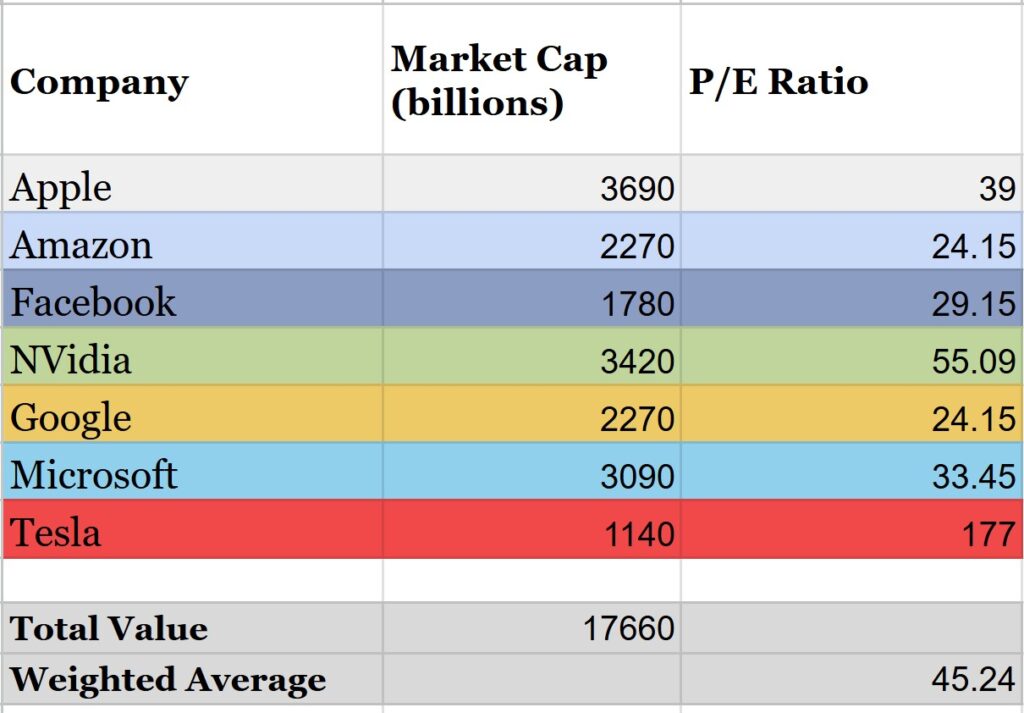
These companies are characterized by their enormous scale, significant profitability, and considerable market hype, particularly around technological innovation. Together, they command over 25% of the S&P 500’s total market capitalization, a staggering $17.66 trillion. Their individual P/E ratios are significantly higher than the rest of the market, with a weighted average around 45, indicative of exceptionally high growth expectations. If these seven companies are excluded from the S&P 500 calculation, the P/E ratio for the remaining 493 companies drops to a more "reasonable" (though still above average) 20. This stark divergence highlights that while the overall U.S. economy is expected to remain healthy, investors are betting on these tech behemoths to deliver disproportionately faster growth.
Artificial Intelligence: The Core Driver of Hype
The common thread uniting the recent boom in these tech giants is the transformative potential of Artificial Intelligence. Recent advancements in AI, particularly in areas like large language models and generative AI, have astonished the business world with their ability to perform human-like reasoning across an expanding array of applications. This breakthrough has ignited a fervor, with industries across the spectrum anticipating a new era of unprecedented productivity and accelerated profit growth.
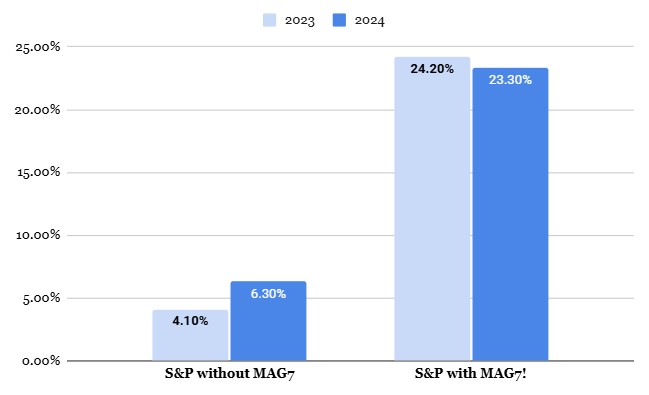
Six of the Magnificent Seven companies are investing hundreds of billions of dollars into building vast data centers filled with cutting-edge supercomputers to power their AI initiatives. NVIDIA, the seventh company, is a primary beneficiary of this spending, manufacturing the specialized chips (GPUs) that are indispensable for AI computations. The immense demand for these chips has allowed NVIDIA to command premium prices and ship products by the trainload, directly translating AI infrastructure investment into substantial revenue growth.
Beyond infrastructure, the applications of AI are rapidly expanding. AI can now analyze complex documents, identify legal loopholes, debug software, drive autonomous vehicles, diagnose medical conditions from imagery with high accuracy, accelerate drug discovery, and even animate humanoid robots for various labor-intensive tasks. The prevailing narrative is that humanity is on the cusp of accessing an almost infinite, highly intelligent workforce that operates at virtually no cost, effectively removing the historical constraints of finite intelligence and labor.
While many experts and investors, including those closely observing the field, believe in the long-term potential of AI, the precise timeline and magnitude of its impact remain uncertain. The critical question for investors is whether the projected profits of these companies will materialize at the levels currently priced into their valuations. Potential challenges include unforeseen cost overruns in AI development and deployment, intensified competition leading to margin compression, regulatory scrutiny, and even existential risks associated with advanced AI systems. Furthermore, the societal implications, such as widespread job displacement and potential economic upheaval, could introduce significant volatility and unforeseen consequences for the global economy. The concentration of wealth and power in the hands of a few AI leaders, as satirically depicted with a "Sam Altman atop a $100 trillion mountain" scenario, underscores the scale of these potential shifts.
Historical Context and Future Projections
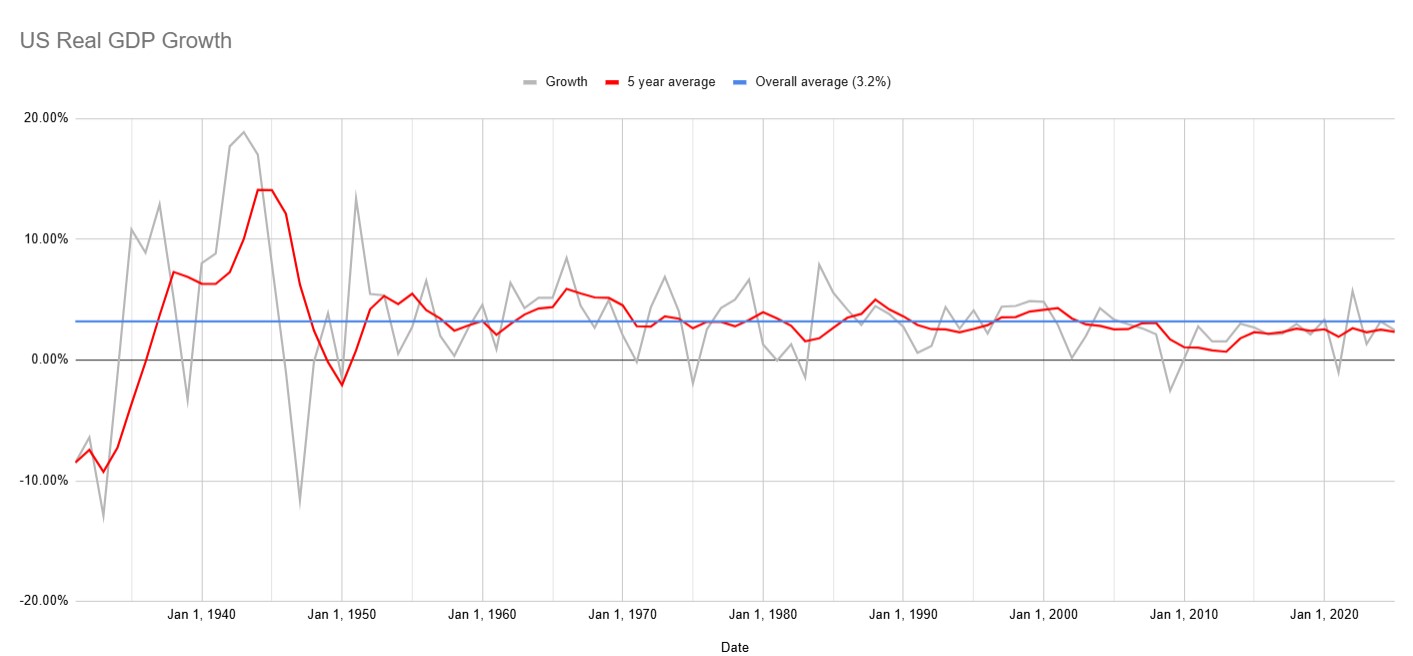
Despite the current excitement, it is crucial to temper expectations with historical economic realities. The history of U.S. economic growth, measured by real GDP, reveals a surprisingly consistent average of about 3% annually after inflation, decade after decade. Interestingly, recent decades have shown a trend of slower than average growth, which, without the AI narrative, would provide even less justification for the current elevated stock market valuations. This historical perspective serves as a reminder that even profound technological shifts typically integrate into the broader economic fabric over time, often without fundamentally altering long-term growth rates beyond a certain range.
Given these dynamics, what course of action should investors take? The consistent advice from seasoned financial strategists remains largely unchanged: for long-term investors, owning stocks will likely continue to be profitable, albeit potentially less so than during periods when stocks were available at lower valuations. Market cycles, characterized by occasional manias, panics, and corrections, are an inherent feature of investing. However, attempting to time these fluctuations—for example, by selling all holdings now in anticipation of a future dip—is historically a losing proposition for most individual investors.
Even if stock valuations revert to more typical historical averages over time, the long-term trajectory of economic growth and corporate earnings is expected to continue upward. This scenario, while potentially yielding lower annual returns than the recent exceptional period, still represents a positive growth path for wealth accumulation. Just as one wouldn’t expect to sell a rental house for a million dollars if it only generates $3,000 in monthly rent, investors should align their expectations for future stock returns with the underlying growth in corporate earnings.
Alternative Investment Strategies and Expert Views

The current market environment encourages a broader look at investment options beyond solely U.S. equities. Vanguard, a cornerstone of index fund investing, annually publishes its 10-year annualized return forecasts. Their most recent projections suggest that international stocks and even bonds are expected to outperform U.S. stocks in the coming decade. This forecast is underpinned by the significantly lower P/E ratio of international equities (e.g., the VXUS fund, representing international developed and emerging markets, has a P/E of around 15.9), indicating that these markets are trading at a substantial discount compared to U.S. counterparts.
However, it is important to note that Vanguard has made similar predictions in prior years, during which U.S. stocks, particularly those driven by the AI boom, have continued to outperform. This highlights the difficulty of forecasting and the potential for new technological paradigms to defy historical averages, at least in the short to medium term.
Diversified portfolios, such as those managed by robo-advisors like Betterment, aim to mitigate risk and potentially enhance returns by allocating investments across various asset classes, including international stocks and bonds, and automatically rebalancing. While such strategies may have lagged a U.S.-only portfolio during the recent tech-driven bull market, they are designed for long-term resilience and can potentially catch up if market dynamics shift as suggested by Vanguard’s analysis. The weighted average P/E ratio for a typical diversified core portfolio from Betterment stands at approximately 22, offering a more balanced valuation profile than a concentrated S&P 500 portfolio.
Warren Buffett, the renowned "Oracle of Omaha," consistently offers insights into market conditions. His company, Berkshire Hathaway, has been conspicuously holding a substantial cash pile, amounting to $334 billion. This considerable liquidity signals Buffett’s view that investment opportunities offering attractive valuations are scarce in the current market. Berkshire Hathaway itself, with an average P/E ratio of about 21 in recent years, is considered by its management to be slightly overvalued, leading them to temper share repurchases. This conservative stance from a legendary value investor further reinforces the notion of elevated market prices.
Another pragmatic financial consideration involves debt management, particularly mortgage debt. While historically, keeping a mortgage and investing surplus cash into index funds has often yielded superior returns, the calculus changes when expected stock returns are lower and interest rates are higher. For instance, a mortgage with a 7% interest rate currently presents a relatively close trade-off with projected stock market returns. From a risk-adjusted perspective, paying off a 7% mortgage offers a guaranteed return equivalent to a 7% bond, which is a highly attractive and secure option, especially compared to leaving substantial funds in low-yield checking or savings accounts. The emotional peace of being mortgage-free is also a significant, albeit unquantifiable, benefit for many.
The Enduring Principles of Long-Term Investing
Ultimately, the core tenets of prudent long-term investing remain constant, regardless of market fluctuations or technological shifts. For the vast majority of investors, the most effective strategy involves consistency: maintaining a disciplined investment approach, regularly contributing to diversified index funds, and resisting the urge to react impulsively to daily news headlines or market volatility.
Instead of expending mental energy on market timing or speculative ventures, investors are often better served by focusing on factors within their control: saving consistently, minimizing expenses, and investing in their own physical and mental well-being. Engaging in activities that provide tangible, guaranteed returns, such as physical activity and spending time in nature, offers benefits that far exceed the unpredictable gains of market speculation. While staying informed through reputable sources like The Economist can provide valuable context, constant monitoring and emotional reactions to market noise are counterproductive.
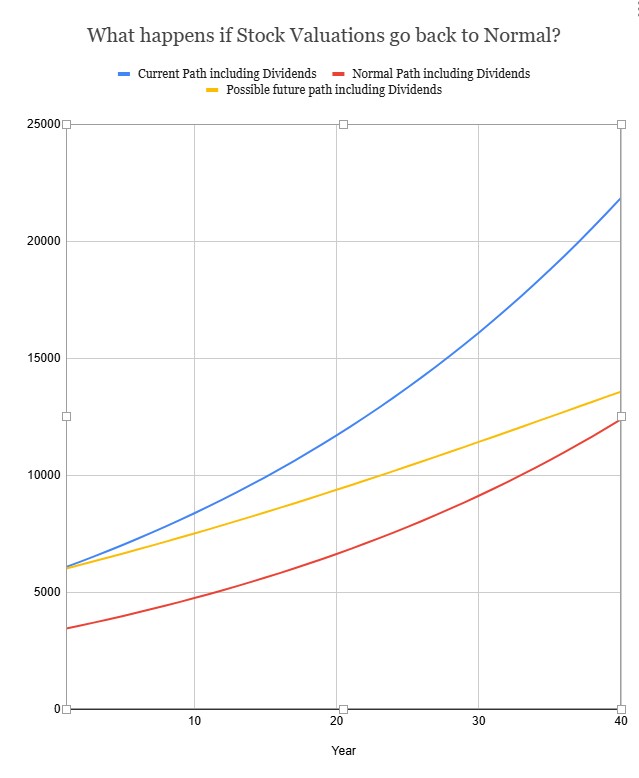
The current market, with its AI-driven exuberance and elevated valuations, presents a complex picture. While the potential of AI is undeniable, the future remains inherently uncertain. Investors who adhere to fundamental principles of diversification, long-term perspective, and emotional discipline are best positioned to navigate these evolving dynamics and achieve their financial goals.

