

The burgeoning PropTech sector, a dynamic intersection of technology and real estate, constantly faces a critical challenge: the acquisition and management of reliable, nationwide property data. While the development of robust data infrastructure might seem like a logical progression for growing platforms, the reality is far more complex. The pursuit of comprehensive, up-to-date property datasets often demands months, if not years, of intensive engineering effort. This protracted timeline clashes directly with the market’s insatiable demand for rapid innovation and trustworthy solutions in an intensely competitive real estate landscape. In this environment, a strategic partnership offering a ready-made real estate data API emerges as a compelling, and often necessary, alternative to the arduous task of building proprietary data systems from the ground up.
This approach allows PropTech companies to bypass the significant engineering hurdles and upfront investments associated with data collection, normalization, and maintenance. Instead, they can leverage pre-existing, analytics-ready property data and investment insights, freeing their internal teams to concentrate on core product development and customer experience. This article delves into the critical "build versus buy" decision for data infrastructure within the PropTech ecosystem, explores how to access accurate and timely real estate data, and outlines strategies for accelerating growth through scalable, externally-provided solutions.
The Inherent Challenges of Building In-House Real Estate Data Infrastructure
While the allure of complete control and customization is undeniable, the practicalities of constructing an internal data infrastructure for real estate are fraught with complexities and considerable expense. What might initially be envisioned as a distinct product feature can swiftly transform into a perpetual operational undertaking. This requires a dedicated engineering workforce, ongoing data licensing agreements, and continuous maintenance to ensure data integrity and relevance.
For teams weighing their options, the path of internal development presents several common pitfalls:
The Hidden Financial and Resource Drain of Building a Data Team
Developing sophisticated real estate data analytics capabilities necessitates specialized expertise, including data engineers, analysts, and domain specialists. The investment extends beyond salaries to encompass robust infrastructure for data ingestion, storage, and processing. The process of building pipelines to collect, normalize, and validate vast quantities of data, while ensuring consistency across diverse markets, is a resource-intensive endeavor. This involves intricate tasks such as data cleansing, deduplication, and the implementation of complex algorithms for feature extraction and anomaly detection.
This prolonged development cycle inevitably slows down product roadmaps and measurable progress. Consequently, the decision to "build" or "buy" data infrastructure often shifts from a matter of strategic control to one of pragmatic speed and long-term sustainability.
A Comparative Analysis: Building vs. Partnering for Real Estate Data
The disparity in timelines, costs, and ongoing responsibilities between building an internal data system and leveraging an API partnership is stark:
| Factor | Building Internally | Partnering via API |
|---|---|---|
| Time to Launch | 6-12+ months | A couple of weeks |
| Upfront Cost | High hiring & infrastructure expenses | Predictable, usage-based pricing |
| Data Maintenance | Sole internal responsibility | Managed by the API provider |
| Coverage Expansion | Slow and manual | Immediate scalability |
| Engineering Focus | Data pipelines and infrastructure | Product innovation and core business objectives |
Navigating Data Licensing, Compliance, and Perpetual Maintenance
The U.S. real estate market, in particular, is characterized by its highly fragmented nature. Multiple Multiple Listing Service (MLS) data sources operate under distinct licensing agreements, with varying update frequencies and data access protocols. Managing these API data licenses, ensuring compliance with terms of service, and navigating permissions across numerous markets is a significant operational challenge.
The complexity escalates further when incorporating specialized analytics, such as rental market performance or short-term rental data. Maintaining accurate datasets, akin to those provided by a dedicated Airbnb data API or an Airbnb historical performance API, demands continuous updates, data normalization across thousands of locations, and rigorous quality control. Without dedicated expertise and infrastructure, data accuracy can fluctuate, eroding user trust and undermining the platform’s credibility. This constant vigilance is a burden that many PropTech companies are ill-equipped or unwilling to bear.
The 12-Month Time-to-Market Hurdle
A significant risk associated with the "build" approach is the potential loss of market momentum. Implementation timelines that stretch to 12 months or more can delay critical product launches, hinder customer acquisition efforts, and erode a company’s competitive advantage in the rapidly evolving PropTech sector. This reality underscores the increasing trend for platforms seeking accelerated results to explore avenues for accessing real estate data without the necessity of building an internal data team. The strategic integration of existing, proven solutions allows companies to redirect their engineering resources toward features that genuinely differentiate their offerings and drive business value.
This paradigm shift towards strategic partnerships naturally raises a crucial question: What does a practical working relationship with a specialized real estate data provider entail?
The Value Proposition of a Real Estate Data API Partnership with Mashvisor
In recognizing the profound complexities and time constraints of developing in-house data infrastructure, many forward-thinking companies are gravitating towards a more agile and dependable alternative: a real estate data API partnership. This model enables businesses to seamlessly integrate readily available, meticulously structured datasets directly into their existing products and workflows. In essence, data transforms from a formidable engineering obstacle into a potent, empowering capability.
Seamless, Plug-and-Play Real Estate API Integration
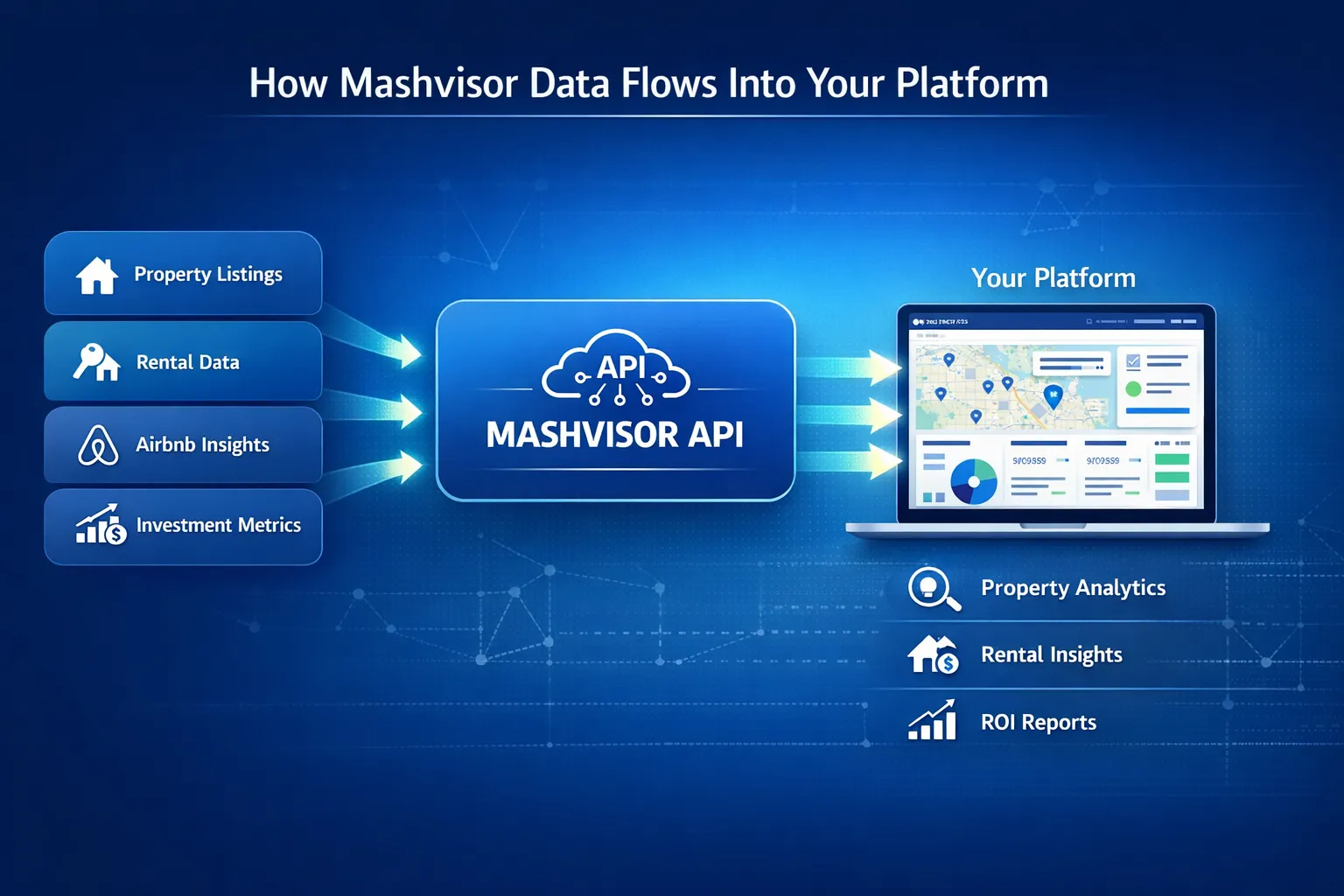
The Mashvisor API is engineered for straightforward integration, providing immediate access to a wealth of property insights, rental analytics, and investment metrics without the need to construct intricate data pipelines. Platforms can connect to standardized endpoints that deliver consistent, analytics-ready information, significantly reducing development complexity. The focus of integration shifts from the laborious task of data aggregation to the more strategic objective of connecting these powerful data streams to existing product workflows, thereby accelerating the journey from planning to deployment.
A thorough review of the Mashvisor API documentation reveals the breadth of available endpoints, datasets, and integration capabilities, offering a clear roadmap for developers.
Comprehensive Property, Rental, and Short-Term Rental Analytics Through a Single API
A significant advantage of collaborating with an established real estate data provider like Mashvisor lies in the access to a comprehensive and unified suite of datasets. Mashvisor consolidates traditional property data with granular insights into rental performance and short-term rental analytics. This integrated approach empowers platforms to deliver deeper market intelligence through a single, cohesive real estate data API.
The Mashvisor API offers a rich array of data points, including:
- Property Details: Comprehensive information on residential and commercial properties, including square footage, lot size, number of bedrooms and bathrooms, year built, and property type.
- Rental Investment Analysis: Key metrics such as average monthly rent, occupancy rates, cash-on-cash return, cap rate, and potential rental income.
- Short-Term Rental (STR) Performance: Data on daily rates, occupancy predictions, potential revenue, and seasonality for platforms focusing on Airbnb and similar services.
- Market Trends and Comparables: Historical sales data, neighborhood analytics, property value trends, and comparable property analysis.
- Mortgage and Financing Data: Information on mortgage rates, loan-to-value ratios, and estimated financing costs to aid in investment calculations.
- Demographic and Economic Data: Relevant local economic indicators and demographic information that can influence real estate values and rental demand.
By consolidating multiple layers of critical data into a single, accessible system, businesses can eliminate the administrative burden and potential inconsistencies associated with managing disparate vendors or fragmented datasets, ultimately delivering a more robust and valuable analytical experience to their users.

Tailored for PropTech Platforms and Property Marketplaces
The Mashvisor API’s architecture is specifically designed to cater to the needs of businesses that prioritize product enhancement over becoming data infrastructure specialists. Mashvisor functions as a foundational layer of data infrastructure, allowing its partners to retain complete control over their branding, user experience (UX), and overall product direction. This strategic alignment positions Mashvisor among the premier real estate data API solutions for companies seeking reliable data integration without the encumbrance of lengthy development cycles.
Beyond simplifying integration, such partnerships fundamentally alter the timeline for launching and scaling new features, offering a distinct competitive edge.
Accelerating Time-to-Market: Launching Features in Weeks, Not Months
In the fast-paced world of real estate technology, speed is not merely an advantage; it is a necessity. Markets evolve with unprecedented rapidity, user expectations are constantly rising, and competitors are perpetually introducing new functionalities. Integrating a real estate investment data API offers a streamlined pathway from concept to market launch, enabling companies to capitalize on emerging opportunities.
Expedited Product Development Cycles
By gaining access to readily available, pre-processed datasets, development teams can bypass the months-long process of data sourcing, cleaning, and validation. This liberates engineers to concentrate on developing user-facing tools that are powered by accurate and reliable property analytics. This accelerated development cycle shortens the time-to-market for real estate platforms, allowing companies to rapidly test new ideas, launch analytical tools, and iterate based on user feedback, rather than being constrained by infrastructure limitations.
A Comparative Look: Data Access Strategies
| State | Internal Data Build | Mashvisor API Integration |
|---|---|---|
| Data Sourcing | Months of effort | Immediate access |
| Infrastructure Setup | Extensive and complex | Minimal technical overhead |
| Testing | Extended, multi-stage cycles | Faster, iterative testing and validation |
| Feature Launch | Significantly delayed | Rapid deployment and market introduction |
Scalable Growth Without Infrastructure Overhaul
The challenges inherent in internal data infrastructure become magnified with business growth, such as expansion into new geographical markets. Platforms that build internally may face significant hurdles in scaling their data operations to accommodate this expansion. Conversely, solutions that scale in tandem with a company’s needs provide the flexibility to expand coverage instantaneously.
Mashvisor’s nationwide real estate data coverage empowers platforms to grow geographically without introducing additional operational complexity or the need for extensive new data sourcing initiatives. Furthermore, Mashvisor’s usage-based pricing model ensures that a company’s data costs scale in direct proportion to its actual data consumption, offering a financially agile approach to growth.
Prioritizing Core Product Value with Focused Engineering Resources
When data infrastructure is managed by a specialized external provider, internal engineering teams are empowered to shift their focus from routine maintenance to core product differentiation. This strategic reallocation of resources allows for enhanced UX improvements, pioneering analytics innovations, and a superior customer experience, all of which are critical drivers of strategic growth. This operational efficiency is a primary catalyst behind the widespread adoption of API data partnerships for real estate platforms. While rapid deployment is crucial, it must be complemented by unwavering reliability, encompassing data accuracy, regulatory compliance, and long-term scalability.
Ensuring Compliance, Coverage, and Scale Without Operational Burden
Launching a product swiftly is only one facet of success. Real estate platforms must consistently deliver high-quality data, reliable updates, and ensure compliant data usage to maintain and build customer trust. Maintaining these stringent standards internally can become increasingly complex and resource-intensive as a business scales.
A real estate data partnership with Mashvisor offers a comprehensive solution to these critical concerns:
Unifying Nationwide Real Estate Data Coverage
This partnership effectively eliminates the need to painstakingly assemble datasets market by market. Mashvisor delivers comprehensive nationwide coverage, enabling platforms to offer users consistent, comparable insights across diverse locations without the overhead of managing multiple vendors or complex integrations. This unified data structure is paramount for ensuring that analytics remain comparable between markets, a non-negotiable requirement for data-driven tools serving a broad user base.
Continuous Data Updates and Proactive Maintenance
The real estate data landscape is in a perpetual state of flux. Listings are updated, rental performance metrics fluctuate, and broader market conditions evolve on a weekly basis. Maintaining the accuracy of these datasets internally demands constant monitoring, validation, and sophisticated data management processes.
Through a real estate data API partnership with Mashvisor, the intricate tasks of data aggregation, normalization, and ongoing updates are expertly handled. Businesses receive meticulously structured datasets that are immediately ready for analysis, thereby significantly reducing their operational burden and the risk of data inaccuracies impacting user decisions. This consistent delivery of reliable data enables teams to provide dependable long-term rental and Airbnb data analytics without the need for dedicated internal resources.
Streamlined Compliance and API Data Licensing
Data compliance, while often an afterthought during initial development, becomes critically important as a business scales. Managing API data licensing agreements, permissions, and usage requirements across a multitude of disparate sources can introduce significant legal and operational risks.
By integrating with Mashvisor, companies sidestep the complexities of direct data licensing. They can rely on an established infrastructure that is designed to manage these licensing considerations and data standardization protocols, freeing their teams to concentrate on their core competencies and strategic objectives.
With the foundational concerns of reliability, coverage, and compliance addressed, the pertinent question becomes: Which types of companies stand to gain the most from such a strategic partnership?
Identifying Key Beneficiaries of a Mashvisor Data Partnership
While a broad spectrum of real estate industry participants can benefit from the Mashvisor API, the advantages are particularly pronounced for PropTech companies and those operating in data-intensive niches.
PropTech Startups: Rapid Validation and Market Entry
Startups operate under immense pressure to validate their business concepts and achieve product-market fit with utmost speed. The laborious process of building internal datasets can severely impede early-stage development and consume scarce engineering resources. Leveraging PropTech API solutions, such as Mashvisor’s, allows startups to launch Minimum Viable Products (MVPs) much faster, while still delivering professional-grade insights and analytics to their initial user base.
Mini Case Study: Launching in 48 Hours Instead of 6 Months
One notable PropTech startup successfully launched a short-term rental (STR) deal validation engine in under 48 hours by integrating Mashvisor’s API. Instead of dedicating months to building data pipelines, sourcing nationwide property listings, and normalizing rental performance data, their lean team focused exclusively on product development and user experience. This agile approach enabled them to rapidly test market demand, onboard early adopters, and refine their product based on real-world usage, all without the overhead of hiring a dedicated data team or negotiating multiple complex data licenses.
Real Estate Marketplaces: Enhancing Value Beyond Listings
Property marketplaces and listing platforms are increasingly competing on the depth of insights they offer, rather than solely on the breadth of their inventory. Incorporating advanced analytics, powered by a reputable real estate API provider, allows these platforms to provide significant value beyond mere property listings. This includes offering data on investment potential, projecting rental income, and providing robust market comparisons, thereby differentiating themselves in a crowded marketplace.
Investment Platforms and Specialized SaaS Tools
Platforms catering to real estate investors, brokers, or property managers invariably require sophisticated property analytics across multiple markets. Utilizing an API integration allows these entities to deliver critical metrics such as Return on Investment (ROI), detailed rental projections, and comprehensive market performance insights through a single, unified interface. This facilitates scalable product growth while ensuring a consistent and high standard of data quality.
AI and Analytics Platforms Augmenting Property Intelligence
Rather than embarking on the arduous task of building new data pipelines from scratch, AI-driven platforms are increasingly adopting API data partnerships to seamlessly integrate structured datasets into their sophisticated models and dashboards. Mashvisor provides standardized data outputs and extensive market coverage, enabling companies to incorporate real estate insights into their recommendation engines, forecasting tools, and advanced analytics applications with minimal additional infrastructure development.
Who Leverages the Mashvisor API for Strategic Advantage?
| Platform Type | Primary Benefit |
|---|---|
| PropTech Startups | Accelerated MVP launch and market validation |
| Property Marketplaces | Enhanced user value through an added analytics layer |
| SaaS Tools for Real Estate | Deeper investment insights and decision support |
| AI and Analytics Platforms | Seamless integration of structured real estate data |
The advantages of a Mashvisor data partnership are clear: faster time-to-market, access to reliable and continuously updated data, and the foundation for scalable business growth.
Identifying When a Partnership Might Not Be the Ideal Fit
While the benefits are substantial, a real estate data API partnership with Mashvisor may not be the optimal solution for every organization. It is generally not the right fit for:
- Companies solely focused on direct property transactions without a need for data analytics.
- Entities that require highly niche, proprietary data not covered by standard real estate datasets.
- Organizations with established, large-scale internal data teams already possessing robust infrastructure and specific, complex data processing needs that could not be met by an API.
- Businesses whose primary goal is to become a data provider themselves, rather than a consumer of data.
Mashvisor’s core offering is designed for teams building production-grade tools, platforms, and workflows that depend on reliable, continuously updated data.
The Bottom Line: Strategic Data Integration for PropTech Success
A real estate data API partnership with Mashvisor offers a strategic pathway to bypass the inherent challenges of building and maintaining proprietary data infrastructure. By integrating production-ready datasets, businesses gain access to scalable analytics, comprehensive national market coverage, and dependable property intelligence without the burden of managing complex data operations. Furthermore, Mashvisor’s usage-based pricing model ensures that clients pay only for the data they actively utilize, offering a cost-effective solution that scales with business needs.
By embracing a partnership approach, companies can empower their engineering teams to concentrate on core product innovation and strategic growth, while entrusting a seasoned data provider to manage the intricacies of data aggregation, updates, and scalable infrastructure. This allows PropTech companies to remain agile, competitive, and focused on delivering exceptional value to their end-users.
For organizations contemplating the critical "build versus buy" decision for their real estate data stack, engaging in a dialogue with data experts can illuminate the most effective integration strategy. A focused consultation can map a company’s product roadmap and launch timeline to the most suitable data integration approach, whether an API partnership is the immediate solution or a future consideration. This pragmatic discussion aims to provide clarity on data strategy and accelerate the path to market, without pressure or obligation.
Frequently Asked Questions About Real Estate Data API Partnerships
What constitutes a Real Estate Data API Partnership?
A real estate data API partnership, such as the one offered by Mashvisor, allows businesses to integrate market and property datasets directly into their products. This eliminates the need to build and maintain their own data infrastructure, thereby providing faster access to analytics and significantly reducing engineering and operational complexity.
Why should a company partner with Mashvisor rather than building its own Real Estate Data Team?
Building internal data systems demands substantial time, significant hiring efforts, and ongoing maintenance. In contrast, partnering with a specialized real estate data provider like Mashvisor delivers ready-to-use datasets, accelerates product launches, and reduces overhead costs, allowing internal teams to focus on core business objectives.
What is the typical integration timeline for a Real Estate API?
Most API integrations can be completed within a couple of weeks, though the precise timeline is contingent on the complexity of the specific product. For comparative purposes, developing internal data pipelines from scratch can take multiple months.
What types of data does the Mashvisor API provide?
The Mashvisor API offers a comprehensive suite of data, including property details, rental income estimates, key investment metrics, and specialized insights for short-term rentals. Both current data and historical data (up to 36 months) are available.
Who is the ideal user of a Real Estate Analytics API?
PropTech startups, real estate marketplaces, specialized SaaS platforms, and advanced analytics tools are among the primary beneficiaries of the Mashvisor real estate analytics API.
Are Real Estate Data API Partnerships affordable for startups?
Mashvisor offers usage-based access, which allows startups to align their data costs with their actual data consumption. This model makes the real estate data API an accessible and scalable solution, even for early-stage platforms with limited budgets.

