
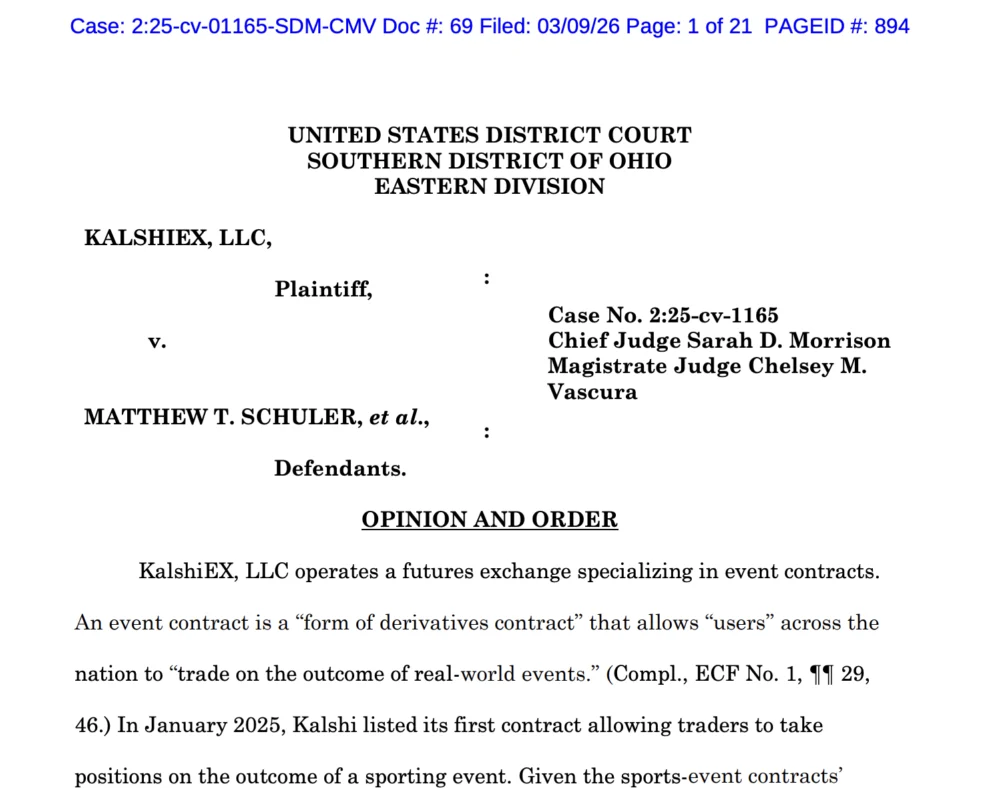
An Ohio federal court has denied a preliminary injunction sought by prediction markets platform Kalshi, a decision that could significantly impact the regulatory landscape for such platforms across the United States. Kalshi had argued that federal commodities laws, specifically those overseen by the Commodity Futures Trading Commission (CFTC), superseded Ohio’s state-level gambling regulations, thereby granting the platform exclusive jurisdiction. However, Chief Judge Sarah Morrison of the U.S. District Court for the Southern District of Ohio found Kalshi’s arguments unconvincing, ruling that the company failed to demonstrate that sports event contracts on its platform fell under the exclusive purview of the CFTC or that federal law preempted Ohio’s sports gambling statutes.
This ruling marks a setback for Kalshi and other prediction market operators who have been advocating for federal oversight and challenging state-level attempts to regulate their activities as illegal gambling. The core of Kalshi’s argument rested on the assertion that its contracts, which allow users to bet on the outcome of real-world events, including sporting contests, were in fact "swaps" or futures contracts subject to the Commodity Exchange Act (CEA) and the CFTC’s jurisdiction. By claiming exclusive federal jurisdiction, Kalshi aimed to shield its operations from the licensing and regulatory requirements imposed by individual states, many of which view such platforms as engaging in unlicensed sports betting.
The court’s detailed order, filed on Monday, directly addressed Kalshi’s claims of federal preemption. Judge Morrison explicitly stated that even if the court were to acknowledge that sports-event contracts are swaps under the CFTC’s purview, Kalshi had not sufficiently proven that the CEA would necessarily preempt Ohio’s sports gambling laws. This distinction is crucial: the court did not rule on whether sports event contracts are definitively "swaps" but rather on whether the CEA’s existence automatically overrides state gambling laws in this context.
"Kalshi argues that Ohio’s sports gambling laws are field and conflict preempted by the CEA when it comes to sports-event contracts traded on its exchange," the court’s opinion stated, directly quoting Kalshi’s contention. However, the judge concluded, "Kalshi fails to establish that Congress intended the CEA to preempt state laws on sports gambling." This indicates a judicial reluctance to broadly interpret federal commodities law as a blanket shield against state regulation of activities that bear strong resemblances to traditional forms of gambling.
Background: The Rise of Prediction Markets and Regulatory Uncertainty
Prediction markets, also known as forecasting markets or information markets, are exchanges where individuals can buy and sell contracts whose payoffs are linked to the outcomes of future events. These events can range from political elections and economic indicators to sporting results and even pop culture trends. Proponents argue that these markets serve as valuable "truth machines," aggregating collective wisdom and providing efficient price discovery for uncertain outcomes. They contend that by allowing individuals to bet on event outcomes, these markets incentivize informed participation and accurate forecasting.
Kalshi, founded in 2015, operates a platform that offers contracts on a wide array of events. However, its foray into offering contracts based on sports outcomes has placed it squarely at odds with state gambling regulators. States generally have stringent licensing requirements and prohibitions against unlicensed sports betting, viewing it as a significant societal concern due to potential for addiction, fraud, and illicit activity.
The legal battle between Kalshi and state authorities highlights a broader regulatory gray area. While the CFTC has historically asserted jurisdiction over certain derivative contracts, including some that might resemble prediction market instruments, its explicit stance on prediction markets, particularly those focused on sports, has been evolving. The CFTC, under Chairman Rostin Behnam, has shown a growing interest in these markets, with some commissioners viewing them as potentially beneficial information aggregation tools. However, this interest has not necessarily translated into clear-cut guidance that would preempt state-level gambling regulations.
The Commodity Futures Trading Commission (CFTC) is an independent agency of the U.S. government established to regulate the commodity futures and options markets. Its mandate is to protect market users and the public from fraud, manipulation, and abusive practices related to the sale of commodity and financial futures and options, and to foster open, competitive, and financially sound markets. The CEA, the primary legislation governing the CFTC, defines what constitutes a commodity and the types of derivative contracts that fall under its jurisdiction. Kalshi’s argument hinged on the interpretation that sports event contracts qualify as "swaps" or other regulated instruments under the CEA.
Chronology of the Legal Challenge
Kalshi’s legal challenge in Ohio followed similar actions in other states. The company had previously sought to block regulatory actions against it, arguing for federal preemption. The Ohio lawsuit was initiated by Kalshi against the Ohio Casino Control Commission and the state’s Attorney General, seeking to prevent them from enforcing state gambling laws against the platform.

Key dates and developments in this unfolding regulatory saga include:
- February 2024: CFTC Chairman Rostin Behnam indicated that the federal regulator was working to provide guidance regarding prediction markets "in the very near future." This statement suggested a potential shift in the CFTC’s approach, possibly moving towards greater clarity or a more active assertion of its role.
- Prior to the Ohio Ruling: Kalshi and other prediction platforms had faced legal challenges and regulatory scrutiny in various U.S. states over allegations of operating unlicensed sports betting. In some instances, judges have issued rulings that have either blocked state crackdowns or are still under consideration, creating a patchwork of legal precedents.
- Monday’s Ruling: U.S. District Court for the Southern District of Ohio Chief Judge Sarah Morrison denied Kalshi’s motion for a preliminary injunction, ruling that federal commodities laws did not necessarily preempt Ohio’s sports gambling laws.
This denial is particularly significant as it runs counter to some of the assertions made by Kalshi and, to some extent, the narrative that the CFTC itself has exclusive jurisdiction. CFTC Chair Michael Selig, in February, had stated that the CFTC had "exclusive jurisdiction" over prediction markets and had alluded to potential legal action against authorities challenging this assertion. However, Judge Morrison’s ruling in Ohio appears to question this broad claim of exclusive federal jurisdiction in the context of state gambling laws.
The court’s statement regarding the CFTC’s inaction is noteworthy: "This Court does not endeavor to explain why the CFTC has not exercised its authority […] with respect to the sports-event contracts. But the agency’s inaction is not proof that the sports-event contracts are regulated by or permissible under the CEA—and the Court has concluded they are not." This suggests that the court viewed the CFTC’s historical lack of direct regulatory action on these specific types of contracts as not automatically validating Kalshi’s claims of federal supremacy.
Supporting Data and Legal Precedents
The legal arguments in this case revolve around the complex interplay of federal and state regulatory authority, particularly concerning the definition of financial instruments and the scope of gambling laws.
- Federal Preemption: This legal doctrine allows federal law to supersede state law. For Kalshi to succeed, it needed to demonstrate that Congress intended the CEA to preempt state gambling laws in this specific area. This typically involves showing either express preemption (where Congress explicitly states its intent) or implied preemption (where federal law is so pervasive that it occupies the field, or where state law conflicts with federal objectives).
- CFTC Jurisdiction: The CFTC’s jurisdiction is generally limited to "commodity futures" and "swaps." Whether sports event contracts fall neatly into these definitions has been a subject of debate. The CFTC has historically regulated futures on broad economic indices and agricultural commodities. While it has expanded its oversight to include some financial instruments, the application to event-based contracts, especially those mirroring the structure of sports betting, has been less clear.
- State Gambling Laws: States have broad authority to regulate or prohibit gambling within their borders. These laws are designed to protect public welfare, prevent crime, and ensure fairness in betting activities. Ohio, like many states, has specific statutes governing sports betting, which typically require licensing, taxation, and adherence to strict operational standards.
- Judicial Splits: The legal landscape for prediction markets is not uniform. As Kalshi’s spokesperson noted, the Ohio ruling "splits from a decision from a federal court in Tennessee just a few weeks ago." This indicates a lack of consensus among federal courts on how to interpret federal commodities law in relation to state gambling regulations for prediction markets. Such judicial splits often highlight the need for clearer legislative or regulatory guidance.
Official Responses and Reactions
Kalshi’s immediate reaction to the ruling was one of disappointment and a commitment to further legal action. A spokesperson for Kalshi stated, "We respectfully disagree with the Court’s decision, which splits from a decision from a federal court in Tennessee just a few weeks ago, and will promptly seek an appeal." This indicates that the legal battle is far from over and that Kalshi intends to pursue its argument in higher courts.
The Ohio Casino Control Commission and the State Attorney General’s office, having successfully defended against the injunction, are likely to view this as a validation of their authority to regulate activities they deem to be sports betting within the state. Their objective is to ensure that any form of betting on sports events occurring in Ohio adheres to the state’s established legal framework, which includes licensing and consumer protection measures.
The CFTC’s stance remains a critical factor. While Chairman Behnam has signaled an increased focus on prediction markets, the agency’s actual regulatory actions and pronouncements will significantly shape the future of this industry. The Ohio court’s comment on the CFTC’s "inaction" suggests that relying solely on the CFTC’s implicit approval or lack of direct intervention might not be sufficient to fend off state regulators.
Broader Impact and Implications
The denial of Kalshi’s injunction in Ohio has several significant implications for the prediction market industry and its regulatory future:
- Strengthened State Regulatory Authority: The ruling empowers Ohio and potentially other states to continue asserting their regulatory authority over prediction markets that offer sports-related contracts. This could lead to increased enforcement actions and a greater push for platforms to comply with state-specific gambling laws, including obtaining licenses and paying relevant taxes.
- Increased Legal Uncertainty: The divergence in court rulings, as highlighted by Kalshi, creates an environment of legal uncertainty for prediction market operators. Companies will need to navigate a complex and potentially conflicting web of federal and state regulations, making long-term strategic planning challenging.
- Urgency for Federal Guidance: The ongoing legal battles underscore the urgent need for clear federal guidance or legislative action regarding prediction markets. The CFTC’s promise of forthcoming guidance is highly anticipated, as it could either clarify federal jurisdiction, establish a consistent regulatory framework, or potentially reaffirm the division of powers between federal and state regulators.
- Potential for Market Segmentation: If prediction markets are forced to comply with stringent state gambling regulations, it could lead to a fragmentation of the market. Platforms might choose to operate only in jurisdictions where they can obtain licenses or where regulatory frameworks are more favorable, potentially limiting access for users in other states.
- Debate on Innovation vs. Protection: The case exemplifies the ongoing tension between fostering technological innovation in financial markets and protecting the public from the potential harms associated with gambling. Regulators and courts are tasked with finding a balance that allows for legitimate information aggregation while safeguarding against exploitative practices.
The decision in Ohio is a significant development in the ongoing regulatory debate surrounding prediction markets. It signals that federal commodities law, while important, may not automatically preempt state gambling laws when it comes to sports event contracts. As Kalshi pursues an appeal, and as the CFTC moves toward providing its own guidance, the legal and regulatory landscape for these innovative platforms is set to remain a dynamic and closely watched area. The outcome of these developments will have far-reaching consequences for how prediction markets operate, are regulated, and are perceived by the public and governing bodies across the United States.

