

Mashvisor has announced the launch of its advanced Application Programming Interface (API), designed to provide developers, investors, and PropTech innovators with unified access to a vast array of real estate data. This new offering aims to streamline the process of property analysis, underwriting, deal screening, and portfolio automation by delivering clean, structured, machine-readable data through a single, robust interface. The API consolidates property attributes, short-term rental (STR) and long-term rental (LTR) analytics, comparable property valuations, Automated Valuation Model (AVM) data, MLS-style marketplace listings, and historical Airbnb performance metrics. Each data endpoint is engineered to return structured JSON, facilitating seamless integration into sophisticated analytical workflows and automated investment platforms.
The imperative for such a unified data solution has grown significantly within the real estate industry. Traditional methods relying on fragmented spreadsheets, laboriously scraped online listings, and incomplete market reports are increasingly inadequate for the demands of modern real estate operations. Developers of PropTech solutions and sophisticated investors require a reliable, structured data feed that can be directly incorporated into underwriting models, predictive forecasting engines, and automated investment decision-making tools. Mashvisor’s API directly addresses this need, offering a consolidated real estate data interface that integrates property details, LTR analytics, detailed Airbnb metrics, and overall investment returns. This comprehensive data is made readily accessible via RESTful endpoints, empowering users to drive their analyses and applications with unparalleled data intelligence.
Understanding the Mashvisor API: A Unified Real Estate Data Ecosystem
The Mashvisor API serves as an extensive real estate data interface, granting programmatic access to the full spectrum of Mashvisor’s property, market, rental, and Airbnb datasets. It consolidates multiple real estate data verticals into a singular RESTful endpoint structure, presenting a unified solution for investors, analysts, PropTech founders, and enterprise teams seeking scalable, accurate, and dependable real estate intelligence across the entire United States market. This integration is designed to eliminate the need for developers to stitch together disparate APIs, offering instead a singular system for building applications, underwriting tools, arbitrage calculators, and forecasting models. For investors, this translates to the ability to conduct more in-depth market analysis and rental property underwriting, thereby assessing investment potential at scale with greater efficiency and accuracy.
How the Mashvisor Real Estate API Operates: Architecture and Integration
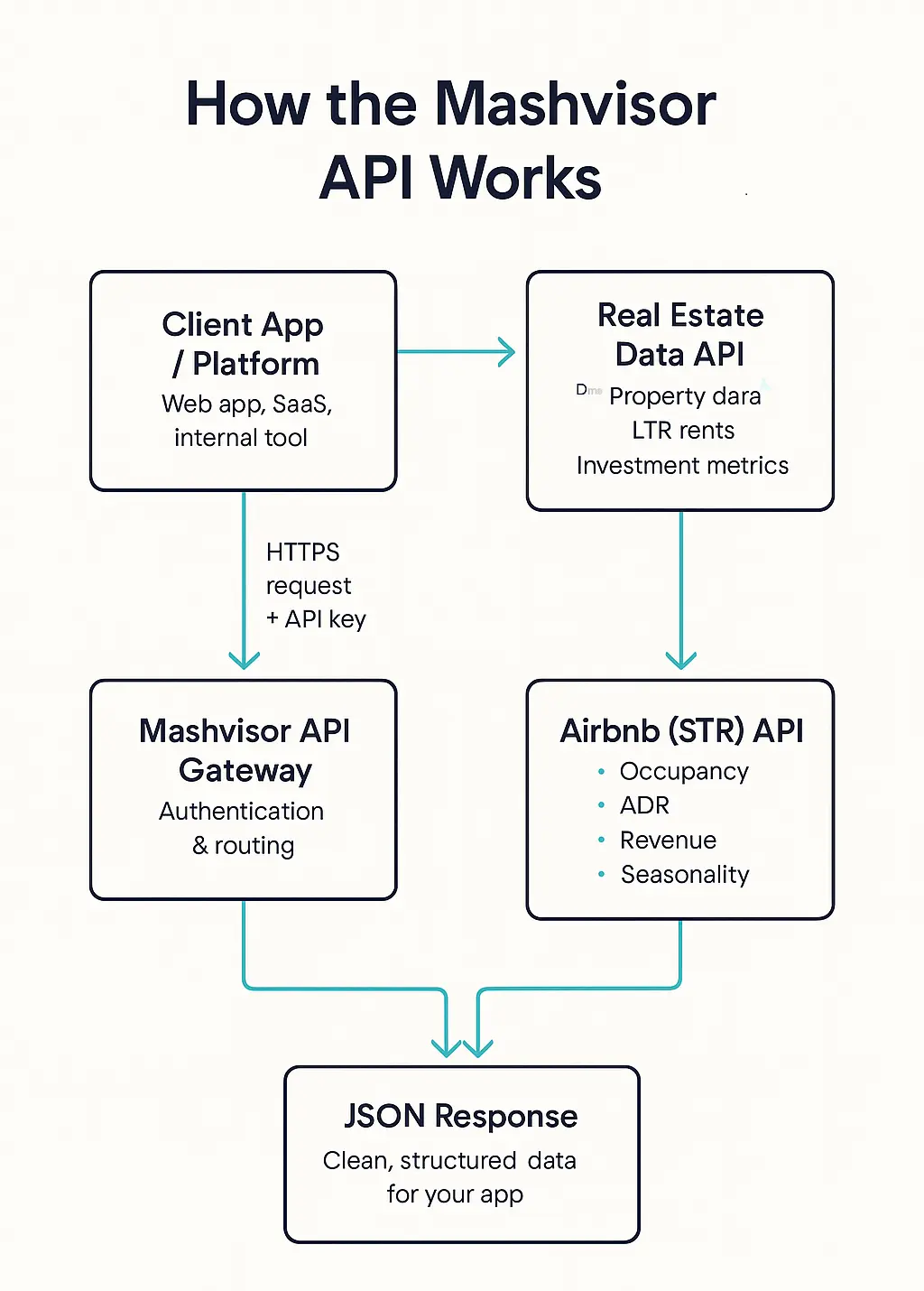
The Mashvisor Real Estate API functions as a RESTful, JSON-based interface. This design allows developers to retrieve clean, machine-readable real estate data through authenticated HTTP requests. Each endpoint is meticulously crafted to deliver structured data that is consistent, predictable, and primed for immediate ingestion into analytical workflows, valuation engines, or custom-built applications.
The API’s Architectural Framework
Mashvisor’s API architecture is built upon a stable schema that logically organizes data into distinct objects. These objects include comprehensive property details, market trends, rental rate estimations, short-term rental performance metrics, and neighborhood-level investment indicators. This structured approach ensures that developers can easily map the incoming data into their specific applications, whether for underwriting models, forecasting engines, deal screening tools, or portfolio management dashboards.
The API’s operational flow begins with client applications authenticating via the API gateway. This gateway then routes incoming requests to either the Real Estate Data API or the Airbnb API, depending on the nature of the query. The APIs process these requests, drawing from multiple underlying data sources, and subsequently return structured JSON responses. This architecture is designed for efficiency and reliability, ensuring that users receive accurate and actionable data for their diverse real estate endeavors.
Developer Interaction and Integration
Developers can access and integrate with the Mashvisor API through various methods. The API is designed to be language-agnostic, supporting any programming language capable of making standard HTTP requests, including widely adopted languages such as Python, JavaScript, Java, Ruby, and PHP. This broad compatibility eliminates the need for proprietary libraries, allowing for rapid integration by developers with existing skill sets.
For instance, a typical integration workflow in Python might involve importing the requests library, defining an API key for authentication, specifying the target endpoint URL, and setting the appropriate headers. A GET request is then sent to the API, and the response, formatted as JSON, is parsed and utilized within the application. A similar process can be achieved using command-line tools like curl. This straightforward interaction model significantly reduces the technical barrier to entry, enabling developers to quickly embed Mashvisor’s rich real estate data into their projects.
Operational Applications for Analysts and Investors
Beyond direct development, the Mashvisor Real Estate API empowers real estate analysts and investment teams to automate critical operational tasks. This includes automating property valuations by leveraging AVMs and comparable sales data, streamlining deal screening through programmatic access to property attributes and market metrics, and automating rental income forecasting for both short-term and long-term rental scenarios. The API also facilitates the automation of portfolio performance tracking and the generation of detailed market analysis reports, significantly enhancing the efficiency and scale of investment operations.
Exploring the Mashvisor API Endpoint Suite
The Mashvisor API offers a comprehensive suite of endpoints, each designed to provide specific types of real estate data. Understanding these endpoints is crucial for developers and investors to effectively leverage the API’s capabilities.
Mashvisor API Endpoint Summary
| Endpoint | Purpose | Use Case | Key Data Returned |
|---|---|---|---|
/client/properties |
Property-level attributes & metadata | Valuation, Deal analysis, Property search tools | Basic property attributes, structure, beds/baths, pricing, coordinates, status |
/client/get-property |
Full property profile with enhanced data | Deal analysis, Underwriting, Valuation models, Comps search | Tax history, assessment history, transaction records, photos, Mashvisor AVM, Redfin-style valuations, nearby comps |
/client/airbnb/listings |
Airbnb performance metrics | STR revenue forecasting, Airbnb comps | Occupancy, ADR, revenue, RevPAR, seasonality, active comps |
/client/airbnb-property |
Detailed Airbnb listing information | STR comps, Amenities parsing, Arbitrage analysis, Listing enrichment | Amenities, images, host metadata, min-stay rules, calendar patterns, listing details |
/client/rental-rates |
LTR rate estimates | LTR analysis, Rental arbitrage | Median rents (1-5 BR), rent distributions, local rental trends |
/client/neighborhoods |
Neighborhood-level analytics & investment indicators | Market evaluation, Neighborhood scoring | Neighborhood ROI, STR/LTR benchmarks, demand indicators, comps |
/client/historical_performance |
Up to 36 months of monthly STR performance | Forecasting, Time-series modeling, Underwriting | Month-by-month occupancy, ADR, revenue, seasonality patterns |
/client/search |
Programmatic property search | Deal-finding engines, PropTech applications | Paginated property search results with filters (price, beds, type, location, status) |
/client/city/listings |
Search Marketplace investment listings | Bulk ingestion, MLS-style search, Deal screening, Lead generation | MLS-like listings, status, DOM, price/price history, ROI indicators, property attributes, distress flags, filters |
All endpoints adhere to a consistent structure, thoroughly documented in the Mashvisor API documentation.
The Power of Multi-Source Data Aggregation
The comprehensiveness of the Mashvisor API is underpinned by its sophisticated data engine, which aggregates information from a diverse range of proprietary, public, and third-party sources. This multi-source methodology enables Mashvisor to provide an exceptionally thorough and continuously updated dataset encompassing property intelligence, STR performance, neighborhood analytics, and long-term rental pricing.

Key Data Sources Integrated
- Airbnb Platform Data: Mashvisor actively monitors activity on the Airbnb platform, collecting real-time and historical data crucial for STR performance analysis. This includes metrics like occupancy rates, average daily rates (ADR), monthly revenue, revenue per available room (RevPAR), and seasonality trends.
- MLS and Real Estate Records: Integration with Multiple Listing Service (MLS) feeds and partner listing providers ensures accuracy at the property level, covering details such as property tax history, assessment records, transaction histories, and visual data like photographs.
- Public Records and Government Data: Standardized public datasets, including property deeds, tax assessments, zoning information, and building permits, are incorporated to enhance property identification, location intelligence, and compliance verification.
- Rental Platforms and Public Rental Data: To support both traditional buy-and-hold investors and rental arbitrage operators, Mashvisor aggregates data from various rental platforms and public sources, providing insights into long-term rental rates and market trends.
- Predictive Modeling and Internal Analytics: Mashvisor employs proprietary advanced modeling techniques to refine data accuracy, interpolate missing points, and validate existing data. These internal analytics ensure consistency across markets, even where raw data might be limited.
This blended data strategy is a cornerstone of Mashvisor’s value proposition, enabling the delivery of accurate, reliable, and actionable real estate intelligence.
Diverse Data Categories for Comprehensive Analysis
The Mashvisor API provides a wide range of data categories designed to meet the needs of various real estate professionals.
Short-Term Rental (STR) Performance Metrics
Mashvisor’s Airbnb API returns structured STR performance indicators. This includes:
- Occupancy Rate: The percentage of days a property is booked.
- Average Daily Rate (ADR): The average rental income per occupied day.
- Monthly Revenue: Projected monthly earnings based on occupancy and ADR.
- RevPAR (Revenue Per Available Room): A key performance metric combining occupancy and ADR.
- Seasonality: Identification of peak and off-peak booking periods.
- Active Listings: The number of comparable Airbnb listings in the vicinity.
This data is invaluable for forecasting, revenue modeling, underwriting, STR pricing automation, and ROI analysis.
Long-Term Rental (LTR) Data
The Mashvisor rental data API covers essential LTR indicators such as:
- Median Rents: Average rental rates for properties with varying bedroom counts (1-5 bedrooms).
- Rent Distributions: A breakdown of rental rates within a specific market.
- Local Rental Trends: Insights into the overall health and direction of the long-term rental market.
These metrics are crucial for assessing traditional rental investment opportunities, comparing STR versus LTR performance, and evaluating rental arbitrage potential.
Property Data and Attributes
The property data API offers detailed attributes for individual properties, including:
- Property Type: Single Family, Condo, Townhouse, etc.
- Bedrooms and Bathrooms: Essential for understanding property size and capacity.
- Square Footage: The total living area of the property.
- Year Built: Historical context for property condition and potential renovation needs.
- Property Status: Active, Pending, Sold, Off-Market.
- Address and Geolocation: Precise location data for mapping and analysis.
This data empowers the development of robust real estate search, valuation, and portfolio management tools.
Investment Indicators and Analytics
Mashvisor integrates built-in analytics designed for investment decision-making:
- Cash-on-Cash Return: The annual return on the cash invested.
- Cap Rate (Capitalization Rate): A measure of a property’s profitability relative to its price.
- ROI (Return on Investment): Overall profitability of an investment.
- Net Operating Income (NOI): Profitability after deducting operating expenses.
- Cash Flow: The net income generated by a property after all expenses, including debt service.
These indicators are ideal for PropTech platforms building automated valuation or underwriting engines and are essential for specialized analyses like rental arbitrage.
Leveraging the API for Rental Arbitrage and Market Coverage
Mashvisor’s unique combination of STR and LTR data makes its API particularly well-suited for rental arbitrage analysis. Users can effectively analyze:
- STR Revenue Potential: Estimating income from short-term rentals.
- LTR Rental Income: Projecting income from long-term rentals.
- Arbitrage Spread: The difference between potential STR revenue and LTR rental income.
- Operating Expenses: Estimating costs associated with both STR and LTR operations.
This dual-data-layer advantage distinguishes Mashvisor’s API from STR-only solutions.
Extensive US Market Coverage
Mashvisor provides nationwide US coverage, encompassing:
- All 50 States: Comprehensive data across the entire country.
- Major Metropolitan Areas: Detailed analytics for large cities and their surrounding regions.
- Smaller Cities and Towns: Data availability extends to less populated areas, offering a granular view of diverse markets.
This broad coverage makes Mashvisor suitable for national real estate investment firms, individual investors seeking diverse opportunities, and PropTech companies aiming for broad market reach.
Visualizing API Responses and Getting Started
To illustrate the structure and content of the data, Mashvisor provides sample JSON responses. These examples showcase how STR and property metrics are presented, enabling developers to visualize the nested objects, data formatting, and overall structure they can expect.
Sample JSON Responses
Sample JSON #1: Property Data and STR Metrics
This example combines core property details with key STR performance indicators:
  "status": "success",
  "content":
    "property_id": 4589210,
    "smart_location": "Las Vegas, NV, US",
    "property_type": "Single Family Residential",
    "bedrooms": 3,
    "bathrooms": 2,
    "list_price": 435000,
    "airbnb_metrics":
      "occupancy_rate": 0.73,
      "average_daily_rate": 188.50,
      "monthly_revenue": 4123.75,
      "revpar": 137.61,
      "active_listings": 570
    ,
    "long_term_rent":
      "rent_1br": 1400,
      "rent_2br": 1750,
      "rent_3br": 2100
    ,
    "investment_metrics":
      "cash_on_cash_return_str": 0.112,
      "cap_rate_str": 0.087,
      "cash_on_cash_return_ltr": 0.053,
      "cap_rate_ltr": 0.041
Sample JSON #2: Airbnb Listing Details
This response focuses on specific Airbnb listing performance and comparable data:
  "status": "success",
  "content":
    "listing_id": 22991433,
    "property_type": "Apartment",
    "bedrooms": 2,
    "bathrooms": 1,
    "smart_location": "Chicago, IL, US",
    "airbnb_stats":
      "occupancy_rate": 0.68,
      "average_daily_rate": 154.20,
      "maximum_monthly_revenue": 3560,
      "minimum_monthly_revenue": 1880,
      "annual_revenue": 39200,
      "seasonality_index":
        "january": 0.72,
        "june": 0.95,
        "august": 0.98,
        "november": 0.65

    ,
    "comparables": [

        "listing_id": 22991210,
        "occupancy_rate": 0.70,
        "adr": 148.00,
        "monthly_revenue": 3200

    ]
These examples provide a tangible representation of the data structure, enabling developers to anticipate and process API responses effectively.
Benefits and Potential Drawbacks of the Mashvisor API
The Mashvisor API offers several key advantages for its users:
- Comprehensive Data Integration: Unifies diverse data sources into a single API.
- Structured JSON Output: Ensures machine-readability and easy integration.
- Scalability: Designed to handle large volumes of data requests for enterprise solutions.
- Accuracy and Depth: Leverages a multi-source approach and proprietary analytics.
- Cost-Effectiveness: Provides competitive pricing structures for various user needs.
- Developer-Friendly: Supports common programming languages and standard protocols.
While the API is robust, potential users should be aware of minor technical limitations common in high-volume real estate data APIs, such as rate limits and credit-based consumption. However, Mashvisor offers flexible plans and enterprise solutions to accommodate high-volume demands, ensuring that these limitations are manageable for most users.
Getting Started with the Mashvisor API
Initiating the use of the Mashvisor API is a straightforward process:
- Visit the Mashvisor Data API Page: Access the dedicated API section on the Mashvisor website.
- Explore Pricing and Plans: Review the available subscription tiers and select one that aligns with your data needs and usage volume.
- Sign Up for a Free Trial: All plans typically include a free trial period, allowing users to test the API’s capabilities with a set number of credits.
- Obtain API Credentials: Upon signup, users receive an API key for authentication.
- Integrate and Analyze: Begin integrating the API into your applications or workflows using the provided documentation and endpoints.
Conclusion: A Powerful Tool for Real Estate Intelligence
The Mashvisor API represents a significant advancement in real estate data accessibility, offering a unified, comprehensive, and developer-ready solution. By consolidating property data, STR and LTR analytics, valuation metrics, and historical performance data into a single interface, it empowers investors and PropTech developers to conduct deeper, more accurate analyses and build sophisticated applications. Whether for large-scale institutional investment, individual portfolio management, or innovative PropTech development, the Mashvisor API provides the accuracy, depth, and functionality required for high-level performance in today’s dynamic real estate market.
For immediate access and to explore its capabilities, users are encouraged to start a one-week free trial, which includes 30 credits, allowing for a practical evaluation of the API’s extensive features.

