
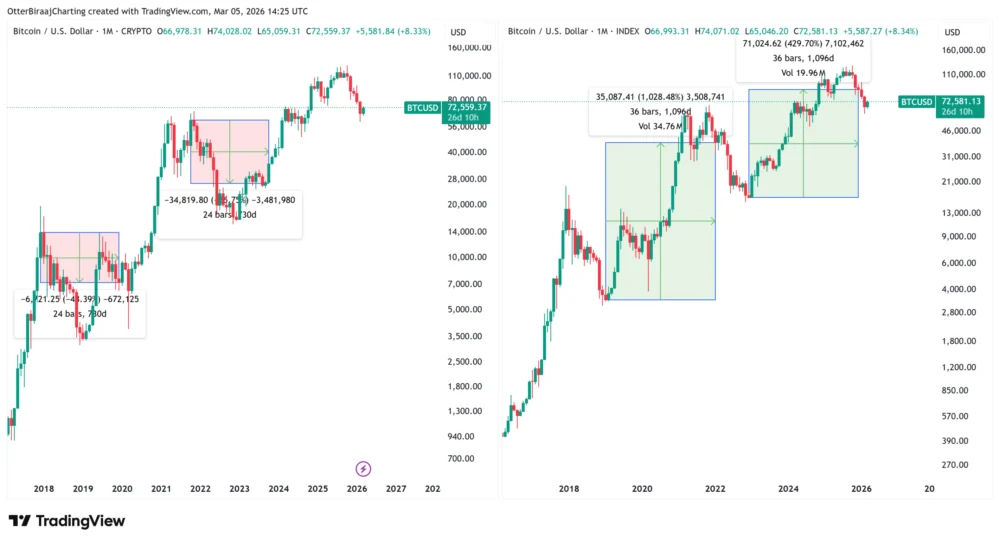
Bitcoin (BTC), the pioneering cryptocurrency, has often been characterized by its dramatic price swings, leading to significant losses for investors who enter the market at its peaks. However, a deeper examination of historical data reveals a compelling narrative: patience and a long-term investment horizon can transform seemingly punitive drawdowns into substantial gains. Analysis of Bitcoin’s performance since 2017 indicates that investors who bought near market highs, experiencing losses of 40% to 50% within two years, have often seen their positions turn profitable when held for over three years. Conversely, strategic entries near bear market lows have historically yielded triple-digit percentage returns over similar two to three-year periods, a phenomenon further illuminated by on-chain valuation metrics that pinpoint these accumulation zones.
Understanding Bitcoin’s Cyclical Performance
Bitcoin’s price trajectory is widely acknowledged to be cyclical, influenced by a confluence of technological developments, market sentiment, regulatory shifts, and macroeconomic factors. Understanding these cycles is crucial for investors seeking to navigate the volatile digital asset landscape. The data presented underscores a critical distinction in investment outcomes based on the timing of entry and the duration of holding.
The Two-Year vs. Three-Year Holding Period: A Tale of Two Outcomes
When examining shorter holding periods, Bitcoin’s performance can appear highly volatile. Investors who entered the market near the 2017 peak, a period marked by unprecedented enthusiasm and speculative fervor, faced a harsh reality. After two years, by the end of 2019, these positions had depreciated by approximately 48.6%, a significant drawdown that would deter many short-term traders. However, the narrative shifts dramatically when this holding period is extended. Those same investors, who maintained their Bitcoin holdings for three years, saw their initial losses transform into a remarkable gain of 108.7% by the end of 2020. This period coincided with the early stages of the next bull run, driven by renewed interest and increasing institutional adoption.
A similar pattern emerged in the subsequent market cycle. Investors who purchased Bitcoin near the all-time highs reached in late 2021 encountered substantial paper losses. After two years, by late 2023, these positions were down by an average of 43.5%. Yet, the extended three-year horizon, reaching into late 2024, saw these same entries recover to a positive return of 14.5%. While this gain is more modest compared to the previous cycle’s three-year outcome, it still signifies a recovery from significant paper losses, reinforcing the principle of long-term holding.

The Power of Accumulation During Bear Markets
In stark contrast to entries near market peaks, strategic investments made during bear market troughs have historically generated exceptional returns. Data indicates that buyers who entered Bitcoin positions close to the 2019 market bottom experienced staggering returns. After two years, these positions had appreciated by an astounding 871%, and by the end of the third year, this figure climbed to an impressive 1,028%. This period represented a significant recovery and subsequent bull market phase, underscoring the potential for outsized gains when acquiring assets at discounted valuations.
The 2022 market downturn, characterized by macroeconomic headwinds and industry-specific challenges, presented another opportunity for strategic accumulation. Investors who initiated Bitcoin purchases near the cycle low in 2022 witnessed substantial gains. After two years, these positions yielded approximately 465% in returns, and after three years, they continued to perform strongly, generating around 429%. This demonstrates that even with different market conditions, buying during periods of significant price depreciation has historically been a highly rewarding strategy for Bitcoin investors.
On-Chain Valuation Metrics: Guiding the Way to Accumulation Zones
The consistent pattern of higher returns from bear market entries can be further explained by Bitcoin’s on-chain valuation metrics. These metrics provide insights into the economic health and investor behavior within the Bitcoin network, helping to identify periods of accumulation and potential price floors.
The Significance of Realized Price
One of the most informative on-chain metrics is Bitcoin’s "realized price." This metric calculates the average acquisition price of all Bitcoin coins based on their last on-chain movement. It effectively represents the cost basis for all Bitcoin holders. When Bitcoin’s market price experiences deep drawdowns, it frequently extends towards the realized price. Furthermore, the "shifted realized price," which smooths the metric forward over time, highlights stronger value zones that have historically acted as support levels during market downturns.
Since 2015, these realized price bands have repeatedly coincided with Bitcoin’s cycle lows. Recoveries from these zones have historically initiated multi-year rallies, demonstrating their significance as key accumulation areas. Currently, Bitcoin’s realized price is estimated to be around $55,000, while the shifted realized price hovers near $42,000. These figures provide valuable context for current market valuations and potential support levels.

The correlation between these realized price bands and bear market lows is striking. Investors who strategically accumulated Bitcoin near market bottoms typically entered when the price was trading at or below these key valuation bands. This suggests that periods of significant price depreciation, when coupled with the underlying fundamentals indicated by on-chain metrics, represent opportune moments for long-term investment.
Institutional Perspectives on Long-Term Holding
The wisdom of long-term Bitcoin holding is not solely based on historical price action; it is also supported by research and analysis from institutional players in the financial industry. The view that Bitcoin, despite its volatility, can enhance traditional portfolios when held for extended periods is gaining traction.
Matt Hougan, Chief Information Officer at Bitwise, has highlighted research indicating that the inclusion of Bitcoin in a traditional 60/40 portfolio has consistently increased both cumulative and risk-adjusted returns across all studied three-year periods. This suggests that Bitcoin can act as a diversification tool, potentially improving overall portfolio performance without necessarily increasing risk disproportionately, especially over longer horizons. The optimal allocation for such a strategy, according to this research, appears to be around 5%, striking a balance between exposure and risk management.
Further analysis by Bitwise, examining Bitcoin data from July 2010 to February 2026, provides compelling statistics on the diminishing probability of loss with longer holding periods. When Bitcoin is held for three years, the probability of experiencing a loss falls to a mere 0.7%. This risk further reduces to 0.2% over a five-year holding period and, remarkably, reaches zero for ten-year holding periods. This data strongly supports the argument that Bitcoin is a long-term investment, and the longer an investor holds, the higher the probability of a positive outcome.
In contrast, shorter holding periods expose investors to considerably more uncertainty. Day traders, for instance, have historically faced a 47.1% chance of losses. Even a one-year holding period still presents a significant 24.3% probability of being "underwater" on an investment. This stark difference in risk profiles between short-term and long-term holding strategies underscores the importance of an investor’s time horizon when considering Bitcoin.
Broader Implications and Market Dynamics
The consistent pattern of Bitcoin’s long-term appreciation, especially when acquired during periods of market pessimism, has several implications for investors and the broader financial ecosystem. Firstly, it challenges the notion that Bitcoin is purely a speculative asset with no intrinsic value. The recurring cycles of recovery and growth suggest an underlying demand and utility that, over time, drives price appreciation.

Secondly, the data highlights the importance of investor psychology and discipline. The temptation to sell during sharp drawdowns, often fueled by fear and short-term market noise, can lead to locking in losses. Conversely, maintaining conviction and adhering to a long-term strategy, particularly when supported by fundamental analysis and on-chain data, can lead to significantly better financial outcomes.
The increasing institutional interest in Bitcoin, as evidenced by Bitwise’s research and the growing number of Bitcoin-related financial products, further validates the long-term investment thesis. As more sophisticated investors enter the market, the potential for greater stability and continued growth over extended periods may increase, although volatility will likely remain a characteristic of the asset class.
The role of on-chain metrics like realized price in identifying accumulation zones provides a data-driven approach for investors to complement traditional technical and fundamental analysis. These tools empower investors to make more informed decisions, potentially reducing the risk associated with timing market entries and exits.
In conclusion, while Bitcoin’s short-term price movements can be daunting, historical data and expert analysis overwhelmingly suggest that a long-term investment horizon is key to unlocking its full potential. By understanding Bitcoin’s cyclical nature, leveraging on-chain valuation tools to identify strategic entry points, and maintaining investment discipline, investors can navigate the inherent volatility and position themselves for significant long-term gains. The narrative of Bitcoin is increasingly shifting from a risky, short-term gamble to a potentially powerful, long-term asset within a diversified investment portfolio.

