
Beijing has proposed a 7% increase in its defense budget for the upcoming year, marking the slowest rate of growth in its annual military expenditure since 2021. This announcement, made during the opening of the National People’s Congress (NPC) on a Thursday in early March 2026, comes at a critical juncture characterized by escalating conflicts in the Middle East, persistent tensions over Taiwan, and a broader fracturing of global geopolitical stability. While the moderation in the growth rate might suggest a strategic recalibration, the absolute increase continues to solidify China’s position as the world’s second-largest military spender, driving a comprehensive modernization agenda aimed at developing advanced combat capabilities and ensuring national security interests.
A Detailed Look at China’s 2026 Defense Budget Proposal
The Ministry of Finance’s budget plan for 2026 outlines the 7% rise in defense spending. This figure, while still substantial, represents a slight deceleration from the 7.2% annual increases budgeted for 2025 and 2024. Prior to that, Beijing had increased military spending by 7.1% in 2022 and 6.8% in 2021, according to official government data. If the 2025 budget was 1.78 trillion yuan ($244.99 billion at the time), a 7% increase for 2026 would push the official figure well past the 1.9 trillion yuan mark, underscoring a sustained commitment to military strengthening despite the slower percentage growth. This continuous upward trajectory contrasts with the more volatile defense spending patterns seen in some other major powers, reflecting Beijing’s long-term strategic vision.
The budget proposal forms a cornerstone of the annual government work report, a key document presented during the NPC, China’s rubber-stamp parliament. The report, delivered by Premier Li Qiang, reiterated Beijing’s strategic priorities: to accelerate the development of advanced combat capabilities and pursue the "high-quality" modernization of its national defense and armed forces. This phrase "high-quality modernization" is significant, indicating a shift from merely increasing numerical strength to enhancing technological sophistication, interoperability, and overall combat effectiveness across all branches of the People’s Liberation Army (PLA). This includes a focus on naval expansion, air superiority, missile technology, cyber warfare, and space capabilities.
Strategic Imperatives: Modernizing for a New Era
China’s defense buildup is driven by a confluence of internal and external factors. Internally, the Communist Party of China views a strong military as essential for maintaining domestic stability and projecting national power. Externally, Beijing perceives a complex and often hostile international environment, necessitating robust defense capabilities to protect its sovereignty, territorial integrity, and growing overseas interests.
Naval Expansion and Power Projection: A key component of this modernization drive is the expansion of China’s naval power. The government work report specifically highlighted the commissioning of the Fujian, China’s first domestically built aircraft carrier, in November 2025. The Fujian, a conventionally powered vessel featuring an advanced electromagnetic catapult system, signifies a monumental leap in China’s naval capabilities. Its operationalization moves the PLA Navy (PLAN) closer to its goal of developing a true blue-water navy capable of projecting power far beyond its coastal waters. This directly challenges the naval dominance of the United States in the Indo-Pacific and allows China to better protect its maritime trade routes, energy supply lines, and interests in disputed territories like the South China Sea. The development of carrier strike groups around vessels like the Fujian is crucial for sustained presence and influence in distant waters.
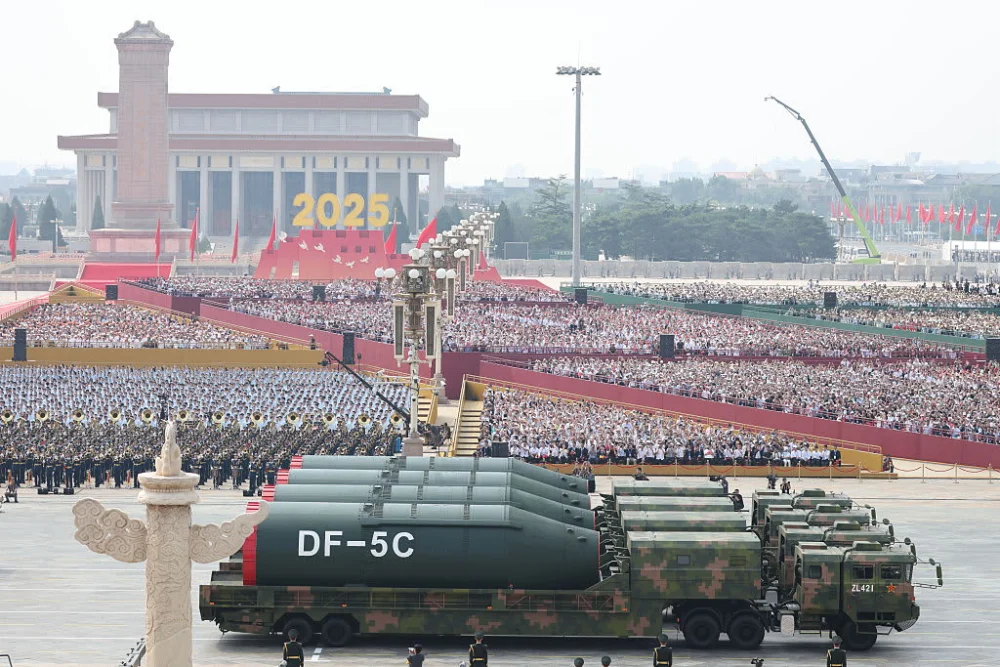
Advanced Missile Technology: The V-Day military parade on September 3, 2025, in Beijing, offered a public display of China’s growing military might. Among the showcased weapon systems were the DongFeng-5C (DF-5C) intercontinental strategic nuclear missiles. These liquid-fueled missiles, touted to possess a global strike range, underscore China’s commitment to enhancing its strategic deterrence capabilities. The DF-5C, an upgraded variant, represents a formidable component of China’s nuclear triad, capable of reaching targets across the globe. The public display of such advanced weaponry serves a dual purpose: to project strength to potential adversaries and to instill national pride domestically. Other advanced long-range missiles, including hypersonic glide vehicles, are also understood to be a significant focus of the modernization efforts, designed to overcome existing missile defense systems.
Cyber, Space, and Information Warfare: Beyond conventional forces, China is heavily investing in what it terms "intelligentized warfare." This encompasses the integration of artificial intelligence, big data, and advanced computing into military operations, with a particular emphasis on cyber warfare, space capabilities, and electronic warfare. The PLA views dominance in these domains as critical for future conflicts, allowing it to disrupt enemy communications, satellite networks, and command-and-control systems. This focus aligns with the broader global trend of military modernization, where technological superiority often outweighs sheer numerical advantage.
Taiwan and Regional Flashpoints: A Central Focus
The government work report explicitly addressed the sensitive issue of Taiwan, stating that Beijing would "resolutely fight against separatist forces aimed at ‘Taiwan independence,’ and oppose external interference." This firm language underscores that Taiwan remains the most critical national security priority for Beijing and a primary driver of its military buildup. The increased defense spending and modernization efforts are directly aimed at building the capacity to deter, and if necessary, forcibly reunify Taiwan with the mainland.
Cross-Strait Dynamics: Tensions in the Taiwan Strait have been steadily escalating, particularly following recent elections in Taiwan which saw the continuation of a party perceived by Beijing as leaning towards independence. China views Taiwan as an inseparable part of its territory, a stance reiterated frequently by its leadership. The phrase "external interference" is a clear warning directed primarily at the United States, which maintains unofficial relations with Taiwan and provides it with defensive weaponry. The presence of advanced Chinese naval and air assets, combined with a sophisticated missile arsenal, significantly complicates any potential intervention by external powers in a cross-Strait conflict.
South China Sea Disputes: Beyond Taiwan, China’s military expansion also has significant implications for the South China Sea, where Beijing asserts expansive territorial claims disputed by several Southeast Asian nations and opposed by the United States. China has steadily militarized artificial islands in the region, equipping them with airstrips, missile batteries, and radar systems. Increased naval and air capabilities, facilitated by higher defense spending, allow China to enforce its claims more effectively and project power across this vital waterway, which is crucial for global trade and rich in natural resources.
Broader Geopolitical Context: The mention of escalating conflict in the Middle East and broader geopolitical fault lines serves as a backdrop, highlighting China’s perception of an increasingly unstable world. While not directly related to China’s immediate territorial concerns, such global instability can disrupt supply chains, impact international trade, and create new security challenges that China’s growing military aims to address, particularly in safeguarding its "Belt and Road Initiative" investments and personnel overseas.
The Debate Over Transparency: Official vs. Actual Spending
One of the most persistent aspects of China’s defense budget is the significant discrepancy between its officially announced figures and estimates from independent analysts and foreign governments. For instance, while China officially budgeted 1.78 trillion yuan ($244.99 billion at the time) for defense in 2025, the U.S. Department of Defense’s 2025 annual report to Congress on China’s military, released in December 2025, estimated that Beijing’s actual spending in 2024 ranged between $304 billion and $377 billion. This range is approximately 32% to 63% higher than China’s officially announced budget of $231 billion for that year.
"Off-Budget" Items: Analysts attribute this disparity to several "off-budget" items that are not typically included in China’s public defense figures. These can include:
- Research and Development (R&D): Significant investments in cutting-edge military technologies, often conducted by civilian entities or state-owned enterprises, may not be fully accounted for in the official defense budget.
- Paramilitary Forces: The People’s Armed Police, a large paramilitary force responsible for internal security and border defense, often receives funding separate from the PLA’s budget.
- Foreign Arms Acquisitions: Major purchases of advanced weaponry from countries like Russia, while less frequent now due to increased domestic production, might be financed through alternative channels.
- Space Program: While China’s space program has civilian components, its military applications are extensive, and significant portions of its funding could be considered defense-related.
- Veteran Benefits and Demobilization Costs: These substantial expenses may also be handled by other ministries or local governments.
The lack of transparency makes it challenging for international observers to accurately assess the true scale and scope of China’s military buildup. This opacity fuels suspicion and contributes to strategic uncertainty, particularly among neighboring countries and rival powers. The International Institute for Strategic Studies (IISS), in its February 2026 report, noted that Beijing accounted for nearly 44% of Asia’s defense spending in 2025, a significant increase from 39% in 2017. This growing share highlights China’s expanding military influence within the region and its widening lead over other Asian powers.
Global Military Spending Dynamics: China vs. the U.S.
Globally, China remains second only to the United States in terms of military spending. The U.S. budgeted $849.77 billion for defense during its 2025 fiscal year. However, estimates from non-profit organizations like USAFacts indicate that actual U.S. defense spending during that period ended up around $919.2 billion, representing a 2% increase from the prior year and accounting for 13% of the federal budget.
An Arms Race or Strategic Competition? The continuous increases in both U.S. and Chinese defense spending underscore a deepening strategic competition between the two global powers. While the U.S. budget remains substantially larger in absolute terms, China’s consistent and rapid growth, coupled with its focus on specific areas designed to counter U.S. advantages (such as anti-access/area-denial capabilities), is shifting the military balance, particularly in the Indo-Pacific. This dynamic raises concerns about a potential arms race, where each nation’s military advancements spur similar investments from the other, creating a cycle of escalating defense expenditures and heightened regional instability.
The U.S. Department of Defense explicitly frames its budget and strategic priorities around countering China’s growing military capabilities and influence. The substantial U.S. defense budget reflects commitments to alliances, global operations, and maintaining a technological edge, all of which are increasingly viewed through the lens of strategic competition with Beijing.
The National People’s Congress: A Platform for Policy Endorsement
The annual National People’s Congress (NPC), China’s top legislative body, is an 8-day parliamentary meeting that officially approves the government’s budget and development goals for the year. While often described as a ceremonial body, the NPC serves as a crucial platform for the Communist Party to unveil and endorse its policy priorities, signaling its direction to both domestic and international audiences. The approval of the defense budget, alongside other economic and social targets, sends a clear message about the leadership’s unwavering commitment to military modernization.
The "Two Sessions," comprising the NPC and the Chinese People’s Political Consultative Conference (CPPCC), are meticulously orchestrated events designed to project unity, stability, and purpose. The government work report, presented at the NPC, encapsulates the Party’s vision and sets the tone for the coming year’s policies. The detailed articulation of defense goals within this report underscores their centrality to China’s national rejuvenation strategy.
Broader Implications and Future Outlook
The sustained growth in China’s defense spending, even with a moderated percentage increase, carries significant implications. Economically, it represents a substantial allocation of national resources, potentially stimulating defense-related industries but also diverting funds from other sectors. Industrially, it drives innovation and technological advancement within China, potentially yielding dual-use technologies that benefit both military and civilian sectors.
Geopolitically, the implications are profound. China’s enhanced military capabilities are reshaping the strategic landscape of the Indo-Pacific, challenging existing power structures, and raising anxieties among its neighbors. Countries like Japan, South Korea, India, and Australia are closely watching China’s military expansion and responding with their own defense modernizations and strengthened alliances, particularly with the United States. The long-term vision of the PLA, as outlined by President Xi Jinping, aims for a "mechanized, informationized, and intelligentized" military by 2035, capable of fighting and winning wars by 2049, the centenary of the People’s Republic of China.
The 7% increase for 2026, while the slowest in five years, should not be misinterpreted as a reduction in ambition. Instead, it likely reflects a maturing military-industrial complex capable of achieving more with relatively less percentage growth, alongside a potential strategic focus on efficiency and qualitative improvements rather than just quantitative expansion. As global geopolitical fault lines continue to deepen, China’s commitment to a powerful and modern military remains an immutable aspect of its rise as a global power, with far-reaching consequences for international security and stability.

