
Bitcoin (BTC) experienced a notable surge on Wednesday, reaching a four-week high and potentially paving the way for a recovery towards the January monthly close of $78,700. This rally, representing a significant 22% climb from its recent low of $60,000 on February 6th, has nonetheless been met with a degree of skepticism. A deeper examination of on-chain and derivatives data reveals that bearish sentiment continues to hold sway over significant market participants, tempering optimism about a sustained upward trajectory.
Underlying Market Dynamics: A Tale of Two Signals
The current market landscape for Bitcoin presents a dichotomy. While the price action indicates a potential recovery, underlying indicators suggest that professional traders are hedging against further declines. A primary concern highlighted by recent data is the persistent demand for downside protection through Bitcoin options. Specifically, put (sell) options have been trading at a premium of approximately 10% relative to equivalent call (buy) instruments. This divergence from neutral market conditions, where this indicator typically fluctuates between -6% and 6%, is a strong signal of apprehension. The last time such a pronounced premium for puts was observed was in mid-January, a period when Bitcoin was trading significantly higher, near the $95,000 mark.
This heightened demand for puts suggests that a segment of the market, particularly more sophisticated traders, anticipates a potential downturn or at least a lack of significant upside. This cautious stance is further corroborated by the lukewarm demand for bullish Bitcoin futures. The annualized premium, or basis rate, for these futures has remained below the neutral 5% threshold. This indicates a lack of strong conviction from bulls to aggressively bet on further price appreciation in the short to medium term.

The Shadow of Consolidation and Unlocking Losses
The observed weakness in Bitcoin derivatives can be partly attributed to the month-long period of consolidation that followed a sharp 32% crash in the first week of February. However, the lack of robust bullish sentiment, even as prices have pushed above the $73,000 level, points to a more fundamental issue: a significant portion of Bitcoin holders are still underwater on their investments.
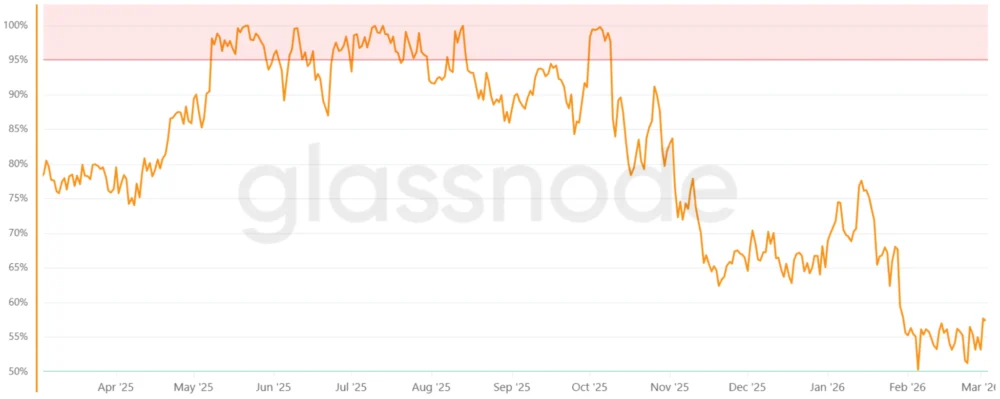
According to data from Glassnode, a leading on-chain analytics firm, approximately 43% of the circulating supply is currently held at a loss, based on the price at which these coins last moved. This figure represents a notable increase from the approximately 30% of holders in loss when Bitcoin was trading at $90,000 in late January. The implication of this widespread unrealized loss is a potential overhang of selling pressure. As Bitcoin’s price recovers, these investors who have been holding onto their positions through the downturn may be incentivized to exit, selling their holdings to recoup their initial investments. This gradual unloading of positions could create persistent overhead resistance, capping further price advancements.
Mining Sector Pressures and Strategic Pivots
Adding another layer of complexity to Bitcoin’s market dynamics is the mounting pressure on the Bitcoin mining sector. The industry has been significantly impacted by the escalating demand for artificial intelligence (AI) computing power. This surge in demand has led to increased energy costs, while simultaneously, the demand for Bitcoin’s blockchain as a registry has seen a relative decline. This confluence of factors has pushed miner profitability to near all-time lows.
In response to these economic pressures, several major publicly listed Bitcoin mining firms have begun to strategically pivot their operations. Reports indicate that these companies are increasingly exploring opportunities in AI computing and high-performance computing (HPC) sectors. This strategic shift often involves divesting Bitcoin holdings to fund new ventures or cover operational expenses. For instance, a notable trend has seen mining companies offloading their accumulated Bitcoin reserves to finance these new AI-focused endeavors.

The impact of this shift can be observed in metrics such as the Bitcoin Hashprice index, which tracks the expected daily value generated by one terahash per second (TH/s) of hashing power. This index has seen a significant decline, plummeting to $30 on Tuesday, down from $39 just three months prior. This reduction in miner revenue raises concerns that miners, who have historically been significant accumulators of Bitcoin, may transition into net sellers. This potential shift in behavior from a key segment of the Bitcoin ecosystem could further exacerbate selling pressure in the market.
Strategy’s Cost Basis: A Potential Turning Point?
The strategic balance sheet approach of companies holding significant Bitcoin reserves, most notably MicroStrategy (MSTR), also plays a crucial role in market sentiment. MicroStrategy, under the leadership of Michael Saylor, has amassed a substantial Bitcoin treasury, acquiring over 720,737 BTC since August 2020. The company’s average acquisition price for its Bitcoin holdings is approximately $76,000.
This cost basis represents a critical psychological and technical level for the market. As Bitcoin’s price approaches or surpasses this threshold, it can influence the behavior of companies like MicroStrategy and other publicly traded entities with similar Bitcoin-centric strategies, such as Metaplanet (3350 JP) and Twenty One Capital (XXI US). While these companies may not face immediate liquidation risks or cash flow issues for their yield-bearing assets, their stock performance is intrinsically linked to Bitcoin’s price.
For bears and market participants looking to suppress Bitcoin’s price, levels above MicroStrategy’s cost basis can incentivize actions that could lead to increased selling. Specifically, when Bitcoin trades above $76,000, it can create an environment where companies like MicroStrategy might consider issuing more stock. This issuance, while potentially beneficial for the company’s operational flexibility, could be perceived by some as diluting existing shareholders if not managed carefully. Consequently, there are incentives for market players to attempt to keep Bitcoin’s price pegged below this $76,000 level.

Therefore, while Bitcoin has demonstrated resilience and a capacity for recovery, a sustained push towards the $78,700 monthly close, and beyond, may encounter significant resistance. The breach of this $76,000 cost basis for key corporate holders could serve as a pivotal moment, potentially shifting momentum decisively in favor of the bulls, but until then, caution is likely to prevail.
Broader Implications and Future Outlook
The current market sentiment surrounding Bitcoin is a complex interplay of price recovery, underlying investor caution, and sector-specific pressures. The demand for downside protection in options markets, the significant percentage of holders in loss, and the financial strains on the mining industry all contribute to a cautious outlook.
The pivot of mining operations towards AI computing, driven by higher potential returns, signals a significant shift in resource allocation within the digital asset ecosystem. This diversification, while a natural evolution of technological and economic landscapes, introduces a new dynamic to Bitcoin’s supply and demand.
The proximity of Bitcoin’s price to key cost bases for large corporate holders, such as MicroStrategy’s $76,000 average acquisition price, highlights potential inflection points. A sustained break above these levels could trigger a cascade of positive sentiment and potentially unlock further upward momentum. Conversely, continued inability to decisively breach these levels could lead to prolonged consolidation or a retest of lower price points.

Market participants will be closely watching on-chain metrics for shifts in holder behavior, especially the behavior of those currently in loss. Any indication of capitulation or, conversely, a strengthening conviction to hold through further volatility, will be critical indicators. The evolving landscape of the mining industry and its potential impact on Bitcoin’s hash rate and miner selling pressure will also remain a key focus.
In conclusion, while Bitcoin’s recent price action offers a glimmer of recovery, the underlying market sentiment remains nuanced. The interplay of institutional hedging, retail investor psychology, and sector-specific economic pressures suggests that the path forward for Bitcoin may be more challenging than a simple price surge might imply. A sustained move higher will likely require a clear break of key resistance levels and a demonstrable shift in the prevailing cautious sentiment.

