
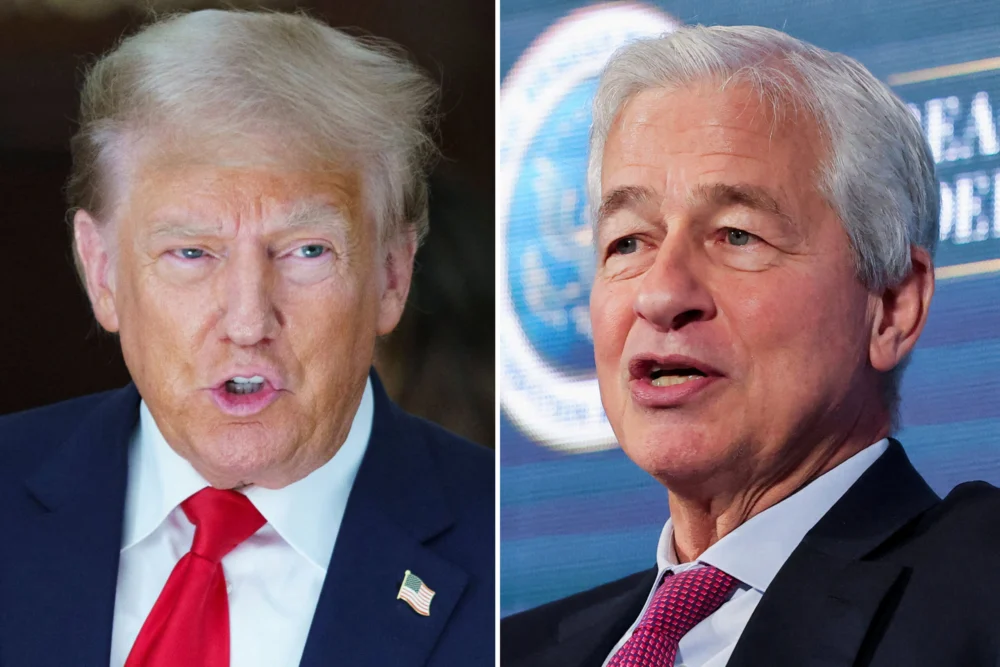
JPMorgan Chase CEO Jamie Dimon recently addressed the ongoing legal battle initiated by former President Donald Trump, who is seeking a staggering $5 billion in damages from the financial institution for the closure of his accounts. While Dimon unequivocally stated that the lawsuit is "without merit," he expressed a surprising degree of empathy for Trump’s frustration, acknowledging that he, too, would be "angry" if subjected to similar circumstances. This intricate position underscores the complex challenges faced by financial institutions navigating an increasingly polarized political landscape while adhering to stringent regulatory requirements.
The core of the dispute revolves around Trump’s assertion that JPMorgan Chase, along with other financial entities, shuttered his accounts for overtly political reasons, a claim echoed by his conservative allies who frame such actions as a form of discrimination. Dimon, speaking on the sidelines of a JPMorgan conference in Miami, offered a candid explanation for the bank’s actions, attributing them not to political bias, but to the pervasive pressure from regulators. He contended that banks are often "forced" to "debank" individuals or entities to mitigate what regulators perceive as "reputational risk," a nebulous yet potent threat that could lead to severe penalties for lenders.
"The case has no merit," Dimon stated, before adding, "But I agree with them. They have the right to be angry. I’d be angry, too. Like, why is a bank allowed to do that?" His subsequent explanation clarified that the motivation stems from a defensive posture against regulatory scrutiny. "We debank people because it causes legal, regulatory risk for us," Dimon elaborated. "It’s been much easier for a bank to say, ‘I’m not taking the risk, let them go bank elsewhere.’" This perspective highlights the often-invisible forces that dictate a bank’s client relationships, transcending mere profitability or customer service.
A Chronology of Contention: From Capitol Attack to Courtroom Battle
The origins of this high-stakes legal confrontation are rooted in the turbulent aftermath of the January 6, 2021, attack on the U.S. Capitol. In the weeks following this unprecedented event, JPMorgan Chase, according to its own recent court filings, conceded that it closed "dozens of accounts" associated with then-President Trump. This period saw a heightened focus across various sectors, including finance, on individuals and entities perceived to be linked to political extremism or actions that could undermine democratic institutions. While no specific law mandates banks to sever ties with customers based solely on "reputational risk," the industry operates within an expansive framework of regulations, guidance, and informal expectations that can render certain clients untenable.
Trump’s legal offensive against Dimon and JPMorgan Chase was formally launched in January 2026, as part of a broader, concerted campaign initiated after he left office. This campaign targets not only financial institutions but also media outlets for alleged defamation and even the IRS over the leak of his tax information. The specific timing of the lawsuit in 2026, as reported, suggests a long-term legal strategy, possibly linked to future political endeavors or a prolonged effort to challenge what he perceives as systemic bias. Beyond JPMorgan, Trump’s companies have also pursued legal action against Capital One over similar debanking claims, underscoring the widespread nature of his grievances against the financial sector.
The Intricacies of "Reputational Risk" and Regulatory Scrutiny
At the heart of Dimon’s defense lies the concept of "reputational risk," a term that, while lacking a precise statutory definition, carries immense weight in the financial industry. For banks, reputational risk encompasses a broad spectrum of potential harm, including damage to public trust, investor confidence, and the potential for regulatory fines or sanctions. This risk can arise from associations with individuals or organizations involved in illicit activities such as money laundering, terrorist financing, fraud, or even highly controversial political figures whose actions might invite intense public and governmental scrutiny.
Financial institutions globally operate under stringent anti-money laundering (AML) and know-your-customer (KYC) regulations, mandated by bodies like the Financial Crimes Enforcement Network (FinCEN) in the U.S. These regulations require banks to conduct extensive due diligence on their clients, monitor transactions for suspicious activity, and report potential violations. Failure to comply can result in colossal penalties, sometimes running into hundreds of millions or even billions of dollars, alongside severe damage to a bank’s standing and operational capabilities. For instance, in 2020, JPMorgan Chase itself paid over $920 million in fines related to spoofing in commodities and treasuries markets, illustrating the severe consequences of regulatory breaches.
While there isn’t a direct regulation stating "do not bank politically controversial figures," the cumulative effect of AML/KYC rules, coupled with guidance from federal agencies like the Office of the Comptroller of the Currency (OCC) and the Federal Reserve, creates an environment where banks become exceptionally risk-averse. Associating with clients who might attract negative media attention, provoke protests, or become targets of government investigations, even if no explicit illegality is proven, can trigger an avalanche of compliance costs, internal investigations, and potential regulatory wrath. This "de-risking" approach often leads banks to terminate relationships with entire categories of customers, including money service businesses, charities operating in high-risk regions, or, as in Trump’s case, politically exposed persons (PEPs) perceived to carry elevated reputational baggage.
Trump’s Broader "Debanking" Campaign and Conservative Backlash
Trump’s legal battles against financial institutions are emblematic of a larger narrative propagated by him and his conservative base: that established corporate entities, particularly in finance, are increasingly weaponizing their services for political ends. This perspective frames the closure of accounts not as a neutral risk management decision but as a politically motivated act of "cancel culture" aimed at silencing or disadvantaging conservative voices. This narrative has resonated deeply with a segment of the population that feels increasingly marginalized by mainstream institutions.
The campaign extends beyond banks. Trump’s lawsuits against media outlets for defamation and the IRS for tax information leaks underscore a comprehensive effort to challenge perceived institutional biases. His legal team likely argues that such debanking practices constitute a violation of due process, infringe upon economic freedom, and are discriminatory, potentially citing protections against arbitrary denial of services. The conservative movement has increasingly called for legislative action to prevent what they term "political discrimination" by financial institutions, advocating for laws that would compel banks to provide services unless a clear legal violation is present.
This debate also touches upon the concept of "Operation Choke Point," an initiative by the U.S. Department of Justice during the Obama administration. Though distinct from the current situation, Operation Choke Point aimed to curb fraud by encouraging banks to cut ties with certain industries deemed high-risk (e.g., payday lenders, gun dealers). Critics then argued it was an overreach that coerced banks into political enforcement. While the current situation with Trump differs in its specifics, the underlying tension — between banks’ right to choose clients and the potential for financial exclusion based on non-criminal factors — remains a potent point of contention.
Jamie Dimon’s Awkward Position and Industry Implications
For Jamie Dimon, one of the most prominent and outspoken leaders in global finance, Trump’s lawsuit places him in an undeniably awkward and precarious position. As CEO of JPMorgan Chase, the world’s largest bank by market capitalization, he must fiercely defend his institution and its practices. Simultaneously, he must navigate the volatile terrain of American politics, where a single social media post from a figure like Donald Trump can send ripples through financial markets and public opinion.
The financial industry, including JPMorgan Chase, has historically benefited significantly from deregulation efforts, a policy stance often championed by Republican administrations, including Trump’s. A cooperative relationship with a potential future administration is invaluable, as deregulation can lead to increased profitability and reduced capital requirements for banks. This strategic consideration adds another layer of complexity to Dimon’s public statements. His acknowledgment of Trump’s anger, despite challenging the suit’s merit, can be interpreted as an attempt to de-escalate tensions and maintain a channel for future engagement, rather than alienating a powerful political figure entirely.
The lawsuit itself, targeting both the institution and its CEO personally, sets a significant precedent. It forces banks to explicitly justify their debanking decisions in court, potentially exposing internal risk assessment protocols and communications. This legal challenge could reshape the landscape of bank-client relationships, particularly for those in the public eye or engaged in politically charged activities.
Broader Implications and the Path Forward
The saga surrounding Trump’s debanking lawsuit against JPMorgan Chase carries significant implications for the broader banking industry, regulatory framework, and political discourse.
- For the Banking Industry: Banks face an unenviable tightrope walk. They must uphold their obligations under AML/KYC laws, manage reputational risk to satisfy regulators and investors, yet avoid the perception of political bias. The lawsuit highlights the need for clearer, more explicit guidance from regulatory bodies on how to handle politically exposed persons and situations involving significant public controversy without appearing to discriminate. Without such clarity, banks will likely continue to err on the side of caution, leading to more instances of "de-risking" and potential legal challenges.
- For Regulatory Policy: The case could spur calls for legislative reform. Advocates for free speech and economic liberty might push for laws that restrict a bank’s ability to terminate accounts based solely on "reputational risk" that isn’t tied to proven illegal activity. Conversely, regulators may emphasize the importance of banks’ autonomy in managing their risk profiles to maintain the integrity of the financial system. This tension could lead to a re-evaluation of the informal guidance and implicit expectations that currently govern bank-client relationships.
- For Political Discourse: The lawsuit further injects the operations of financial institutions into the political arena, deepening the narrative of "cancel culture" and institutional bias. It contributes to a broader distrust in established institutions among certain segments of the population. The outcome of this case could either validate claims of political discrimination or reinforce the idea that banks are merely responding to legitimate regulatory and market pressures.
- Legal Precedent: A ruling in favor of Trump could open the floodgates for similar lawsuits, compelling banks to reconsider their risk management frameworks. Conversely, a ruling in favor of JPMorgan Chase would solidify a bank’s discretion in choosing its clients based on perceived risk, potentially empowering financial institutions further in their de-risking strategies.
Jamie Dimon’s nuanced remarks reflect the intricate and often contradictory demands placed upon financial leaders today. While asserting the legal soundness of his bank’s actions, his empathy for Trump’s anger underscores a recognition of the underlying frustrations with a system where powerful institutions make decisions that can have profound impacts on individuals, often citing opaque regulatory imperatives. As Dimon concluded, "There are a lot of misunderstandings here. Hopefully the law will change, and hopefully it’ll get sorted out." The resolution of this complex legal and political entanglement will undoubtedly shape the future relationship between finance, regulation, and public trust.

