
The global gold market is undergoing a significant transformation, with blockchain-based tokenized gold assets increasingly dictating price discovery during weekends when traditional futures markets are inactive. This shift, highlighted by Iggy Ioppe, former Chief Investment Officer at Credit Suisse and current CIO at liquidity infrastructure firm Theo, signals a growing reliance on decentralized networks for continuous asset valuation, particularly in times of heightened geopolitical and macroeconomic uncertainty.
The conventional gold futures market, primarily driven by the CME Group, operates on a specific schedule. Trading typically ceases at 5:00 PM ET on Fridays and resumes at 6:00 PM ET on Sundays. This 26-hour window leaves a considerable gap in publicly reported price formation. During this period, the vast majority of trading activity migrates to less transparent, over-the-counter (OTC) deals, predominantly in Asian markets, which are not subject to the same level of public scrutiny or real-time reporting as regulated futures exchanges.
"In terms of publicly visible price formation, onchain markets are responsible for virtually 100% of weekend price discovery," Ioppe stated in an interview with Cointelegraph. He further elaborated that the price movements observed on these blockchain-based platforms often influence and align with the opening prices of traditional futures markets when they recommence. "We are seeing weekend moves reflected when CME reopens," he observed, underscoring the growing influence of digital assets on established financial instruments.
This phenomenon is particularly pertinent given the recent surge in the market capitalization and trading volume of tokenized gold. Over the past year, the tokenized gold sector has experienced explosive growth, adding approximately $2.8 billion in value and expanding its market capitalization from around $1.6 billion to $4.4 billion. This represents a remarkable 177% increase, significantly outperforming the broader gold market and most major spot gold Exchange Traded Funds (ETFs). The number of tokenized gold holders has also nearly tripled, with over 115,000 new wallets entering the ecosystem. This expansion accounts for roughly a quarter of all net inflows into the broader real-world asset (RWA) tokenization sector, surpassing the combined growth of tokenized stocks, corporate bonds, and non-US Treasurys.
The Rise of 24/7 Trading and Risk Management
The appeal of tokenized gold lies in its inherent ability to facilitate continuous, 24/7 trading. This offers a critical advantage in risk management, especially during periods of unexpected global events. When traditional futures markets are closed, investors are unable to react to breaking news or adjust their positions in response to developing crises. Tokenized markets, however, provide an immediate avenue for rebalancing portfolios and mitigating potential losses.
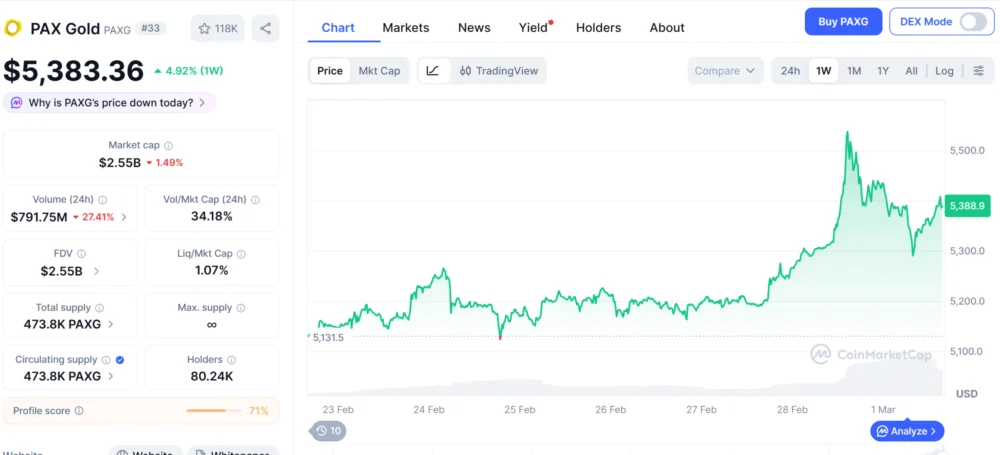
A prime example of this was observed recently when geopolitical tensions escalated following reported US and Israeli strikes on Iran. Over the weekend, tokenized gold assets such as Tether Gold (XAUt) and PAX Gold (PAXG) experienced a significant rally. Investors, seeking safe-haven assets amidst rising global instability, flocked to these digital representations of gold. Data from CoinMarketCap indicated that XAUT briefly surpassed $5,450, and PAXG neared $5,536 during the day, before paring some of their gains. Concurrently, major cryptocurrencies like Bitcoin (BTC) and Ether (ETH) experienced declines, further highlighting the flight to perceived safety in gold.

This ability to execute trades and manage risk around the clock is a compelling proposition for market participants. It allows for a more dynamic and responsive approach to investing in gold, particularly for those who operate across different time zones or require immediate access to liquidity.
Market Dynamics and Participant Behavior
The increased activity in tokenized gold markets is being driven by a diverse group of participants. Market makers and cross-venue liquidity providers are playing a crucial role, actively arbitraging price differentials that emerge between digital and traditional gold markets. Their participation ensures greater liquidity and tighter spreads, making tokenized gold more accessible.
Beyond these institutional players, crypto-native macro traders are also a significant force. They are leveraging tokenized gold not only for direct exposure to bullion prices but also for strategic purposes such as collateralization, hedging against market volatility, and seeking yield during periods of geopolitical or macroeconomic uncertainty. The flexibility and accessibility of tokenized assets allow for innovative deployment in complex financial strategies.
"Some institutions are monitoring weekend onchain gold markets, particularly macro and cross-asset desks that track gap risk ahead of the CME reopen," Ioppe noted. However, he cautioned that while these markets are being observed, most institutions still treat the information gleaned as informational rather than as a direct basis for active positioning. This suggests a cautious approach from larger, more traditional players as they assess the evolving landscape and the reliability of on-chain price discovery.
Explosive Growth Metrics
The trajectory of tokenized gold’s growth is undeniably impressive. The surge in market capitalization to $4.4 billion is a testament to the increasing investor confidence and adoption of this relatively new asset class. The 177% year-over-year increase in market cap is a stark contrast to the more modest gains seen in traditional gold investments, signaling a potential shift in investor preferences, particularly among a younger, more digitally native demographic.
The rise in the number of holders, nearly tripling to over 115,000 new wallets, indicates a broadening base of participation. This democratizes access to gold investment, allowing individuals to invest in smaller, more manageable quantities without the complexities of physical storage or the higher entry barriers of some traditional instruments.

Trading volume has also reached unprecedented levels. With approximately $178 billion in trading volume recorded for tokenized gold in 2025, and a peak exceeding $126 billion in the fourth quarter alone, it is rapidly becoming a dominant investment product. By trading volume, this level of activity would position tokenized gold as the second-largest gold investment product globally, trailing only the SPDR Gold Shares ETF. This substantial trading volume suggests a high degree of liquidity and market depth, essential for attracting institutional capital and ensuring efficient price discovery.
Challenges and Future Outlook
Despite the remarkable growth and increasing influence, tokenized gold still faces several hurdles to widespread institutional adoption. Ioppe pointed out that liquidity, while growing, remains a comparative constraint when measured against the deep liquidity available in traditional futures markets or large ETFs. Executing very large trades in tokenized gold can still lead to significant price slippage, a concern for major institutional investors.
Regulatory clarity is another significant factor influencing the pace of adoption. While progress is being made, the fragmented nature of regulations across different jurisdictions creates complexities for institutions looking to deploy capital globally. Issues surrounding custody, accounting standards, and capital requirements for holding tokenized assets continue to vary widely, posing challenges for compliance and operational integration.
The current outlook suggests that tokenized gold will likely operate in parallel with traditional gold investment products rather than outright replace them in the near term. Each segment serves distinct functions and caters to different market needs and participant preferences. "The most likely near-term evolution is that of tokenized and traditional markets existing in parallel, each serving a different function," Ioppe concluded.
This parallel existence allows for specialization. Traditional markets, with their established infrastructure and deep liquidity, continue to serve large-scale institutional trading and hedging needs. Meanwhile, tokenized gold offers enhanced accessibility, 24/7 trading capabilities, and innovative use cases for a broader range of investors, including retail participants and those seeking more agile financial strategies.
The continued development of the tokenized gold market will likely depend on several key factors: the maturation of the underlying blockchain technology, the establishment of clear and consistent global regulatory frameworks, and the ongoing innovation in financial products and services built upon these digital assets. As these elements converge, tokenized gold is poised to play an increasingly integral role in the global precious metals market, offering a dynamic and accessible alternative to traditional investment avenues. The weekend price discovery role is just the initial indicator of this evolving financial landscape.

