
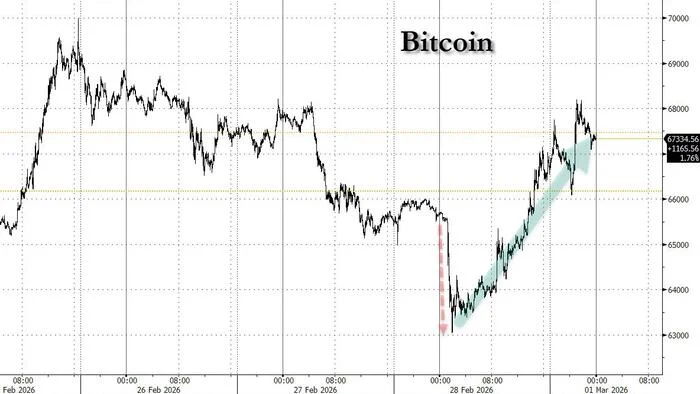
The recent decisive military action against Iran, which saw the swift neutralization of its top leadership and military command, marks the third significant engagement between Iran and a coalition involving the United States and Israel in a span of just over a year. This latest conflict, unprecedented in its scope and immediate impact, has not only reshaped the geopolitical landscape of the Middle East but has also underscored the unique position of cryptocurrencies, particularly Bitcoin, as an always-on barometer for global risk and sentiment, especially during weekend market closures. Unlike previous confrontations that saw initial drops in Bitcoin’s value, this most recent and impactful event culminated in a remarkable rebound, signaling a perceived "all-clear" for traditional markets.
A Chronology of Escalation and Market Reactions
The recent "decapitation" of Iran’s leadership and military command structure on a Saturday morning follows two earlier, less severe, but equally notable engagements that established a pattern of weekend military actions and initial cryptocurrency market volatility. Understanding this chronology is crucial to grasping the strategic calculus behind these operations and the evolving market responses.
April 13, 2024: The Initial Theatrical Exchange
The first instance of a major regional confrontation involving Iran and occurring under the shadow of a future Donald Trump presidency unfolded on April 13, 2024. This event was a direct result of escalating tensions with Israel, culminating in Iran launching "dozens of suicide drones" in what was widely perceived as a retaliatory strike rather than an attempt at fundamental geopolitical reordering. The attack, while a significant escalation in rhetoric and direct action, was largely viewed by international observers and security analysts as a display of capability and a warning shot, carefully calibrated to avoid a full-scale regional war. Israeli defenses, supported by allied nations including the United States, successfully intercepted the vast majority of these drones, minimizing damage and casualties.
This particular weapons exchange, though dramatic, was described by some as having an element of "theatrical appreciation." Both sides appeared to seek a demonstration of resolve without provoking an uncontrollable spiral into a wider conflict. The timing of this attack was strategically chosen: the deep dark of a Saturday morning. With global traditional financial markets – equities, bonds, and commodities exchanges – closed, the immediate impact was primarily confined to the cryptocurrency markets. Bitcoin, the leading digital asset, experienced a sharp knee-jerk reaction, dropping significantly as investors reacted to the sudden surge in geopolitical uncertainty. This initial dip highlighted Bitcoin’s emerging role as a real-time, 24/7 global risk asset, susceptible to rapid shifts in sentiment even when conventional markets are dormant. International reactions were swift, with the UN Security Council convening an emergency session, and major powers urging de-escalation, emphasizing the fragility of regional stability.
June 21, 2025: Operation Midnight Hammer and Nuclear Decapitation
A little over a year later, on June 21-22, 2025, Iran found itself embroiled in a much more serious and aggressive conflict, this time with Donald Trump already in the White House. This operation, codenamed "Operation Midnight Hammer," represented a dramatic escalation in the international community’s efforts to curb Iran’s nuclear ambitions. The assault involved a sophisticated, multi-pronged attack employing airstrikes, cruise missile attacks, and the deployment of B-2 bombers to drop Massive Ordnance Penetrators (MOPs) – powerful bunker-buster bombs designed to destroy deeply buried, hardened targets.
The primary targets were three key Iranian nuclear sites: Fordow, Natanz, and Isfahan. Fordow, built into a mountain near Qom, was known for its uranium enrichment centrifuges. Natanz was Iran’s primary enrichment facility, subject to international inspections, while Isfahan housed a uranium conversion facility. All three sites were quickly and effectively destroyed in a coordinated assault. The precision and overwhelming force of the attack ensured that Iran’s nuclear enrichment process was effectively (and literally) buried under a mountain of rubble. The swiftness and decisiveness of Operation Midnight Hammer left little room for Iranian retaliation in kind, and the major regional conflict was again promptly forgotten by traditional markets after its initial shockwave.
Crucially, this conflict also began in the "deep dark of a Saturday morning," mirroring the timing of the previous incident. Once again, global markets were closed, leaving cryptocurrencies as the only actively traded assets. Bitcoin, in particular, again registered a sharp decline in response to the profound geopolitical instability. The scale of this attack, targeting Iran’s most sensitive strategic assets, sent a clearer signal of intent and capability from the US-Israel coalition. International reactions were mixed; while some nations condemned the unilateral military action, others, particularly those concerned about nuclear proliferation, offered tacit support or acknowledged the gravity of the threat posed by Iran’s nuclear program. The long-term implications included a significant setback to Iran’s nuclear timeline and a re-evaluation of its strategic defense capabilities.
The "Today" Conflict: Decapitation and Unforeseen Market Rebound
Fast forward to the present, and the region has witnessed its most serious conflict between Iran and a coalition of US and Israeli forces in decades. This latest engagement, distinct from its predecessors, aimed for a comprehensive dismantling of Iran’s command and control structure. Iran was "decapitated," with all of its top generals and senior Islamic Revolutionary Guard Corps (IRGC) personnel killed. More significantly, the nation lost its spiritual head, the Ayatollah, who had led the country since the pivotal events of 1978, when Shah Mohammed Reza-Pahlavi was replaced by Ruhollah Khomeini, ushering in the Islamic Revolution and the subsequent hostage crisis at the American embassy.
This conflict diverged from the previous two in its timing, commencing shortly after sunrise on a Saturday. The attacking generals deliberately chose a daytime assault, calculating that a night attack – which Iran would likely anticipate as a "surprise" tactic – would have diminished impact. Their assessment proved correct, as the precision strikes resulted in the prompt neutralization of the Ayatollah and the majority of the army leaders. The implications of this leadership vacuum for Iran are profound, signaling a potential seismic shift in its political trajectory and regional foreign policy.
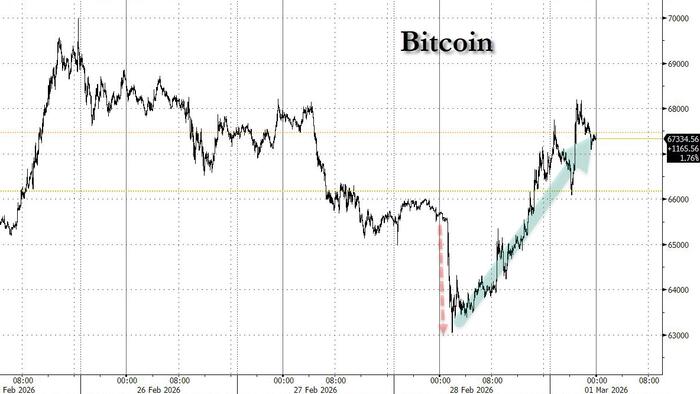
Despite the shift in timing to daylight hours, the fundamental similarity to previous conflicts remained: it began early on a Saturday, when global traditional markets were closed. And, once again, Bitcoin was trading actively. Initially, mirroring the past two regional wars, Bitcoin’s knee-jerk reaction was sharply lower, reflecting the acute uncertainty and fear permeating the global risk landscape. However, what transpired next was unprecedented. Not for long did Bitcoin remain in decline. Shortly after confirmations emerged regarding the death of the Ayatollah and the elimination of most of the army leadership, Bitcoin – that weekend trading risk barometer – staged a remarkable rebound. It not only recovered its early losses but surged to trade well above its pre-conflict levels, specifically higher than where it stood before the initial sell-off shortly after midnight on Saturday East Coast time. This rapid reversal in Bitcoin’s fortunes raised a critical question for global investors and strategists: Is the conflict now effectively over, and is Wall Street receiving the all-green signals for a "risk-on" environment?
Analysis from Academy Securities: A "Risk-On" Outlook
Peter Tchir, a strategist at Academy Securities, provided a late Saturday note that addressed this very question, indicating his comfort with buying the market given the latest developments. His analysis offers crucial insights into why the market might interpret such a profound geopolitical event as a signal for stability rather than prolonged uncertainty.
Oil Market Dynamics and Pricing:
Tchir first points to the oil market, noting that Brent crude had already risen from $60 in late December to $72 on Friday before the latest conflict. While some of this movement was attributable to factors like a cold winter in America, a significant portion was likely priced in due to the escalating risk of conflict. This pre-positioning meant that much of the "bad" news on the oil front was already accounted for by the market.
Furthermore, Tchir highlights a critical "good" news aspect: "nothing has happened that would prevent transit if there is an off-ramp." This suggests that key shipping lanes, such as the Strait of Hormuz, through which a significant portion of the world’s oil supply passes, remained open or were not under immediate threat of sustained closure. This assurance is vital for global energy security. He also notes that "China supposedly has large stockpiles of crude and the U.S. in good shape," indicating that major global economies possess sufficient strategic reserves to absorb a short disruption, perhaps lasting "a week or so," with minimal long-term impact. While spot oil contracts might briefly touch $80, Tchir did not anticipate a significant sustained move higher along the futures curve, suggesting that the supply-demand fundamentals, even with a short disruption, would not be fundamentally altered.
Military Effectiveness and Strategic Recalibration:
Another cornerstone of Tchir’s optimism stems from the perceived effectiveness of the US and Israeli military and intelligence operations. He observed that "intelligence and military in action have delivered at high levels for the US and Israel. Not so much for Iran." This stark contrast in capabilities and execution is a critical factor. The decisive nature of the strikes against Iran’s leadership suggests superior intelligence gathering, precision targeting, and operational execution.
This success, Tchir argues, should force a recalibration of Iran’s (or its successor leadership’s) strategic calculus. With confirmations of severe damage to its leadership, those assuming command face daunting realities:
- Vulnerability: Knowledge that Israel and the U.S. likely possess detailed intelligence on their identities and locations would be profoundly unsettling.
- Superior Weaponry: The coalition’s weapon systems performed as advertised, or "maybe even better than expected," demonstrating a technological and strategic advantage.
- Inferior Iranian Capabilities: Conversely, Iran’s weapon systems, "like in prior attacks, and like Russia has experience," have not performed as well as expected. This disparity diminishes Iran’s capacity for effective retaliation and encourages a path towards de-escalation or seeking an "off-ramp."
Bitcoin as a Risk-On Indicator:
Finally, Tchir zeroes in on Bitcoin. He, along with many market observers, views Bitcoin as a "risk-on" type of asset in this context. Its recovery from an early loss to a slightly higher position after the confirmation of Iran’s leadership decapitation is interpreted as a powerful signal. The market, through Bitcoin’s immediate reaction, appears to be pricing in a swift resolution to the conflict and a reduction in future regional instability, rather than an escalation. This suggests that investors perceive the decisive strike as having eliminated a significant source of future geopolitical risk, thereby fostering an environment conducive to risk-taking.
Broader Impact and Implications
The implications of this latest conflict are far-reaching, extending beyond immediate market reactions to fundamental shifts in regional power dynamics and international relations.
Geopolitical Reconfiguration: The "decapitation" of Iran’s leadership creates an immense power vacuum. This could lead to internal struggles for succession, potentially destabilizing the country further or, conversely, paving the way for a more moderate or pragmatic leadership. The future of the IRGC, a pillar of the previous regime’s power, is now uncertain, potentially weakening Iran’s capacity to project power through proxies in the region. This could lead to a significant re-alignment of alliances and a re-evaluation of security postures across the Middle East. Nations previously wary of Iranian influence might find new opportunities for cooperation, while others might view the situation with apprehension regarding potential chaos.
The Future of Iran’s Nuclear Program: With the nuclear sites destroyed in 2025 and the current leadership dismantled, Iran’s path to developing nuclear weapons has been severely impeded, if not entirely blocked for the foreseeable future. This outcome, while achieved through military means, addresses a core concern of Israel and the US. It will undoubtedly reshape international negotiations regarding Iran’s nuclear capabilities, potentially leading to new frameworks or, in the absence of a stable Iranian government, a period of uncertainty.
Economic Ramifications: While Peter Tchir’s analysis suggests minimal long-term impact on oil prices, the short-term volatility and potential for supply disruptions cannot be entirely discounted in any future scenario. Global trade routes, while currently unaffected, would remain under scrutiny. The broader economic impact hinges on the ability of a post-Ayatollah Iran to establish a stable government and its integration (or lack thereof) into the global economy. A more open, less belligerent Iran could unlock significant economic potential for the region, while continued instability could prolong economic uncertainty.
The Evolving Role of Bitcoin: This series of conflicts cements Bitcoin’s status as a critical, real-time indicator for global risk. Its 24/7 trading nature means it reacts instantly to major geopolitical events, often hours before traditional markets open. The initial "risk-off" reaction followed by a "risk-on" rebound in the latest conflict highlights its sensitivity not just to the occurrence of conflict, but to its perceived resolution and implications for future stability. Investors are increasingly watching Bitcoin’s movements as a bellwether for how global capital views the unfolding of major world events, particularly those with immediate, high-impact characteristics.
Humanitarian Concerns and Hopes:
While the market analysis focuses on financial implications and strategic outcomes, the human cost of such conflicts is immense. As Peter Tchir poignantly notes, amidst the "fog of war" and the "risk-on" outlook, "we can only hope that the events in the Middle East lead to a peaceful resolution, putting the Iranian people on a better path to prosperity and freedom, while minimizing the loss of life for everyone in the region." The long-term stability and well-being of the Iranian populace and the broader Middle East remain the ultimate, and most critical, considerations. The coming weeks and months will be crucial in determining whether this decisive military action ultimately paves the way for a new era of regional peace or ushers in further unforeseen challenges.

