
Bitcoin (BTC) experienced a significant price correction on Friday, plummeting below the $65,500 mark and effectively negating the gains it had secured earlier in the week. This sharp downturn mirrored the intraday movements of the S&P 500, as crucial United States wholesale inflation data triggered a palpable increase in investor risk aversion. Compounding the market’s apprehension was a report from UBS, a prominent investment bank, which downgraded its outlook on US stocks to neutral, likely accelerating a flight towards the perceived safety of fixed-income assets.
The volatility in the cryptocurrency market, particularly for Bitcoin, underscores its intricate relationship with traditional financial markets. While often touted as a digital gold or an uncorrelated asset, Bitcoin’s price action has, in recent times, shown a pronounced sensitivity to macroeconomic indicators and shifts in institutional sentiment towards global equity markets. This latest correction has reignited concerns among investors about a potential "doomsday scenario" for the US equity market, with some speculating that such a downturn could drive Bitcoin to new yearly lows. While the continued significant investment in artificial intelligence (AI) infrastructure remains a talking point for market participants, the long-term trajectory of Bitcoin is unlikely to be solely tethered to the performance of the technology sector.
The UBS Downgrade: A Catalyst for Risk-Off Sentiment
The UBS global equity strategy team articulated concerns that US equity market valuations have become increasingly unattractive when juxtaposed with those in other global regions. Analysts pointed to a confluence of mounting risks, including the potential for a weakening US dollar and persistent US policy turbulence, which collectively are creating asymmetric structural downside risks for the American stock market. Furthermore, the report highlighted a diminishing effectiveness of corporate stock buybacks in their capacity to sustain elevated price levels.
The sheer scale of the US market, with its $70 trillion capitalization, cannot be understated in its ability to influence broader market trends. Even assets that are theoretically uncorrelated, such as Bitcoin, have demonstrated a susceptibility to these powerful market forces. However, it is crucial to note that the UBS report, while signaling caution, is far from a definitive doomsday prediction. The investment bank maintained its year-end target for the S&P 500 at a robust 7,500, suggesting a belief in underlying resilience, albeit with a more cautious outlook on near-term performance.

Inflation Data Fuels Fed Rate Cut Uncertainty
A significant driver of Friday’s market turmoil was the release of the US Producer Price Index (PPI) for January 2026. The data revealed a 0.5% increase from the previous month, a figure that surprised economists and traders alike. When inflation metrics exceed expectations, it invariably casts doubt on the timing and extent of anticipated interest rate cuts by the US Federal Reserve. A persistently restrictive monetary policy, characterized by higher borrowing costs, tends to dampen economic activity by making credit more expensive for businesses and consumers, thereby reducing incentives for production expansion and investment.
The immediate implication of such inflation data is a heightened degree of uncertainty surrounding the Federal Reserve’s forward guidance. Traders and investors recalibrate their expectations, factoring in the possibility that the central bank may need to maintain its current monetary stance for a longer duration than previously anticipated. This uncertainty can lead to a broad-based risk-off sentiment across financial markets, as investors seek to preserve capital in the face of potential economic headwinds.
US Treasury Yields Signal a Shift to Risk-Averse Stance
The US Treasury yield, particularly the 10-year Treasury note, serves as a key barometer of investor risk assessment. During periods of elevated market uncertainty and apprehension, investors typically gravitate towards government bonds, which are considered among the safest asset classes. This behavior is often observed irrespective of prevailing inflationary trends, as the primary objective becomes capital preservation.
In a notable development that underscored the prevailing risk-averse sentiment, the US 10-year Treasury yield experienced an unusual decline, falling to 3.97% from a higher level of 4.21% observed just three weeks prior. This downward trend in yields, occurring concurrently with signs of weakness in the S&P 500 despite positive corporate earnings surprises, signals a significant shift in investor appetite away from riskier assets. The fact that investors are seeking refuge in bonds even when corporate results are not overtly negative suggests a deeper concern about systemic risks within the broader economic landscape.
Valuations and Policy Uncertainty in US Equities
The UBS global equity strategy report further elaborated on the valuation concerns within the US stock market. Analysts highlighted that US stocks are currently trading at a substantial premium of 35% compared to their global peers, a significant deviation from the historical average premium of approximately 4% observed since 2010. This elevated valuation gap, according to UBS, is exacerbated by a series of policy proposals that introduce considerable volatility. These proposals include potential caps on credit card interest rates, the implementation of additional import tariffs, and the possibility of imposing limits on private equity investments in the housing sector.

Despite these concerns, the report acknowledged that the adoption of artificial intelligence (AI) in the US is expected to play a crucial role in sustaining earnings growth across key industries. This optimistic outlook on AI’s impact suggests a nuanced view from UBS, where specific sectors driven by technological innovation might continue to perform well, even as broader market valuations are deemed stretched. The dual narrative of high valuations coupled with specific growth drivers creates a complex investment environment.
Bitcoin’s Potential as a Diversifier in a Risk-Off Environment
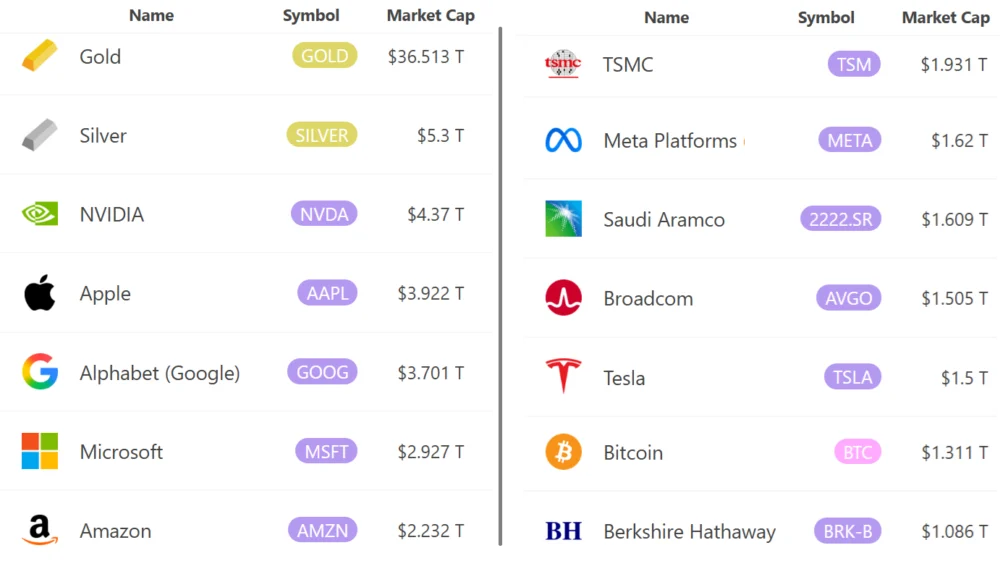
The prevailing market conditions, characterized by potential limitations on the upside for the S&P 500, could pave the way for capital rotation into alternative assets. Gold, long recognized as the ultimate store of value, has already witnessed a significant surge in its market capitalization, reaching an impressive $36.5 trillion. To provide context, the combined market capitalization of the ten largest technology companies globally stands at $24.2 trillion.
Even a substantial rally in Bitcoin’s price, such as a 52% increase to $100,000, would result in a market capitalization of $2 trillion. This figure, while substantial, remains considerably smaller than that of gold. Therefore, unless the current capital rotation primarily benefits fixed-income or real estate markets, Bitcoin remains a compelling candidate for investors seeking to diversify their portfolios and hedge against potential downturns in traditional equity markets. The narrative of Bitcoin as a digital store of value, akin to gold, gains traction during periods of heightened macroeconomic uncertainty.
Institutional Adoption: The Next Frontier for Bitcoin Sentiment
The sentiment surrounding Bitcoin could witness a significant positive shift with the announcement of new strategic Bitcoin reserves by major corporations or sovereign wealth funds. Even if such reserves are established through exposure to exchange-traded funds (ETFs), the act of institutional adoption can profoundly impact market perception. While the timing of such events remains unpredictable, historical precedents, such as Tesla’s significant Bitcoin investment announcement in the past, demonstrate the power of corporate endorsement to favorably alter trader risk perception.
The continued development and adoption of spot Bitcoin ETFs have provided a more accessible avenue for institutional and retail investors to gain exposure to the cryptocurrency without directly managing private keys. The substantial inflows into these ETFs in recent periods, particularly during dips, suggest a growing conviction among investors in Bitcoin’s long-term potential. However, until a more definitive decoupling from the broader US stock market is observed, the correlation between Bitcoin’s price action and the S&P 500 is likely to persist.

Broader Implications for the Digital Asset Landscape
The current market environment presents a critical juncture for Bitcoin and the broader digital asset landscape. The confluence of macroeconomic headwinds, including persistent inflation concerns and a recalibration of Federal Reserve policy expectations, coupled with a cautious outlook on US equities from major financial institutions, creates a complex backdrop.
For Bitcoin, the challenge lies in its ability to assert its uncorrelated nature and serve as a true safe-haven asset or a store of value distinct from the performance of traditional markets. While the narrative of digital gold gains momentum during times of uncertainty, its price action has often remained tethered to the broader risk-on/risk-off sentiment prevalent in global financial markets.
The potential for capital rotation, as suggested by the UBS report, offers a pathway for Bitcoin to attract further investment. If investors begin to de-risk from equities, assets like Bitcoin, with their limited supply and growing institutional acceptance, could emerge as beneficiaries. The increasing accessibility through ETFs has already broadened the investor base, and any further validation through corporate or sovereign adoption could significantly amplify this trend.
However, the immediate future likely holds continued volatility. The sensitivity of Bitcoin to macroeconomic data releases, such as inflation figures, is unlikely to diminish in the short term. Traders will remain vigilant for any signals from the Federal Reserve that could influence interest rate policy, as this remains a primary determinant of risk appetite in financial markets.
The long-term outlook for Bitcoin, while subject to market cycles and regulatory developments, is increasingly shaped by its integration into the global financial system. The ongoing debate about its role as an inflation hedge, a speculative asset, or a digital store of value will continue to evolve as more data and real-world use cases emerge. The current market correction, while unsettling for some, may also be viewed as a natural part of the asset’s maturation process, testing its resilience and solidifying its place within a diversified investment portfolio. The coming months will be crucial in determining whether Bitcoin can effectively navigate the current macroeconomic complexities and solidify its position as a distinct asset class, less susceptible to the whims of traditional market sentiment.

