
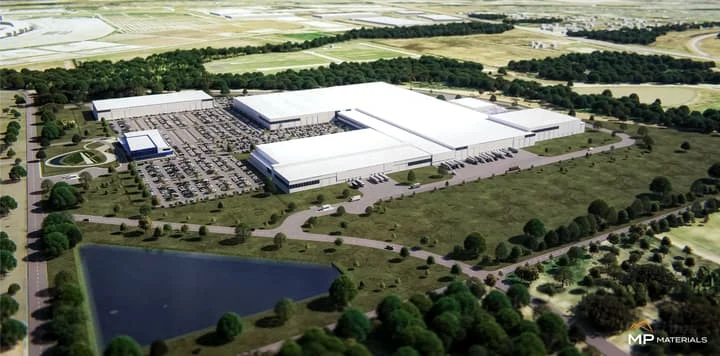
Northlake, Texas – MP Materials, a leading domestic producer of rare earth materials, has announced its selection of Northlake, Texas, as the site for its new $1.25 billion rare earth magnet manufacturing campus. The ambitious project, dubbed "10X," represents a significant stride in the United States’ ongoing efforts to fortify its domestic supply chains for critical metals, which are indispensable across a wide spectrum of modern technologies, from advanced data centers and sophisticated defense systems to ubiquitous personal electronics and electric vehicles. The announcement, made on Thursday, underscores a growing national imperative to reduce reliance on foreign adversaries for essential industrial components.
A Cornerstone of Domestic Rare Earth Production
The "10X" facility is designed to integrate seamlessly with MP Materials’ existing operations, utilizing rare earth raw materials that will be meticulously sourced and processed at the company’s Mountain Pass mine in California. The Mountain Pass facility holds a singular distinction as the only commercial-scale rare earths mine currently operating within the United States. This vertical integration is crucial, ensuring a secure and transparent supply chain from mining to finished product, a stark contrast to the complex and often opaque global networks that have characterized the rare earth industry for decades.
Once fully operational, the Northlake 10X campus is projected to produce approximately 7,000 metric tons of high-performance rare earth magnets annually. This substantial output will dramatically increase MP Materials’ total production capacity, bringing it to an impressive 10,000 metric tons per year. The company already operates another magnet facility in Fort Worth, Texas, which commenced commercial production in 2025. That facility currently contributes about 3,000 tons of magnets per year, serving prominent customers such as General Motors and Apple, illustrating the broad industrial demand for these critical components. The expansion in Northlake signals a robust scaling of operations to meet burgeoning domestic needs.
Addressing a Critical Geopolitical Vulnerability
The establishment of the 10X facility comes at a pivotal moment, as global geopolitical dynamics have increasingly highlighted vulnerabilities within critical minerals supply chains. For years, China has maintained an overwhelming dominance in the rare earth sector, controlling over 90% of the world’s processing, separation capacity, and magnet manufacturing capabilities. This near-monopoly has created a strategic chokepoint, making numerous industrial and defense sectors in other nations highly dependent on Chinese supply.
The inherent risks of this dependence were starkly underscored last year when China strategically curbed exports of certain rare earth materials and related technologies. This move was widely interpreted as a weaponization of its control over the supply chain, shining an international spotlight on the urgent need for diversification and domestic production capabilities in countries like the United States. The consequences of such export controls are far-reaching, impacting everything from the production of advanced weaponry and aerospace components to the manufacturing of electric vehicle motors and wind turbines.

In 2025, U.S. imports of direct rare earth magnets reportedly fell to approximately 6,000 tons, a direct reflection of the export controls and the broader global scramble for secure supplies. While MP Materials’ new factory has the potential to significantly mitigate direct import dependence for magnets, it is crucial to recognize that the overall U.S. demand for rare earth magnets, when considering their embedded use in imported end products such as automobiles and smartphones, remains substantially higher. This complex interplay between direct imports and embedded components highlights the multifaceted nature of achieving true supply chain independence.
A Public-Private Partnership for National Security
The development of the 10X facility is not solely a private sector endeavor but a strategic public-private partnership aimed at bolstering national security and economic resilience. The U.S. government, particularly under the Trump administration, has actively pursued a host of initiatives designed to invigorate domestic mining and processing capabilities for critical minerals. These efforts reflect a bipartisan consensus on the importance of reducing strategic vulnerabilities.
A cornerstone of this partnership is the substantial support provided by the Department of Defense (DOD). Last year, the Pentagon made a significant investment, taking a $400 million stake in MP Materials. This financial commitment was further reinforced by a crucial agreement guaranteeing a minimum price of $110 per kilogram for 10 years for neodymium-praseodymium (NdPr) oxide. NdPr is a vital component used in the production of high-strength permanent magnets, which are essential for numerous defense applications, including precision-guided munitions, radar systems, and advanced propulsion technologies.
Significantly, the entirety of the 10X facility’s output has been committed to the Pentagon for a decade as part of this previously announced deal. This long-term commitment provides MP Materials with a stable demand base, de-risking the substantial investment required for such a large-scale manufacturing operation. While the primary commitment is to national defense, there remains an opportunity for commercial customers to access the material, subject to agreement with the DOD, indicating a potential dual-use capacity for both military and civilian applications.
James Litinsky, founder and CEO of MP Materials, articulated the strategic significance of the project, stating, "We are advancing key objectives under our public-private partnership with the Department of Defense and accelerating America’s rare earth and magnet independence with an uncompromising focus on speed, execution, and delivery." His statement underscores the urgency and strategic intent behind the Northlake development.
Economic Impact and Job Creation
Beyond its strategic implications for national security, the 10X facility is poised to deliver substantial economic benefits to the North Texas region. The project is expected to commence production in 2028 and will be a significant job creator, projected to generate 1,500 direct manufacturing and engineering jobs at the site. These are high-skilled positions that will contribute to the local economy through wages, taxes, and indirect job creation in supporting industries. The influx of investment and high-tech manufacturing expertise will also further solidify Texas’s growing reputation as a hub for advanced industries.

Senator Ted Cruz (R-Texas) lauded the development, emphasizing its critical role in national security. In a statement, Senator Cruz remarked, "The Chinese Communist Party represents the most acute national security threat to the United States, yet we remain dependent on the CCP for critical minerals. MP Materials is building the infrastructure needed to undo that dependence and bolster American national security." His comments reflect the broad political support for initiatives that strengthen domestic supply chains and reduce reliance on geopolitical rivals.
Chronology of Key Developments:
- Pre-2020s: Growing awareness of U.S. dependence on foreign critical mineral supply chains, particularly rare earths, largely dominated by China.
- Late 2020s: Trump administration initiates policies and programs aimed at boosting domestic mining and processing capabilities.
- Last Year:
- China implements export curbs on certain rare earth materials, highlighting global supply chain vulnerabilities.
- The U.S. Department of Defense takes a $400 million stake in MP Materials and guarantees a 10-year minimum price for neodymium-praseodymium oxide.
- U.S. imports of direct rare earth magnets fall to approximately 6,000 tons amid export controls.
- 2025: MP Materials’ existing magnet facility in Fort Worth, Texas, begins commercial production, with a capacity of 3,000 tons per year.
- Thursday (Current Announcement): MP Materials officially selects Northlake, Texas, for its new $1.25 billion "10X" rare earth magnet manufacturing campus.
- 2028 (Projected): The Northlake "10X" facility is expected to begin production, contributing 7,000 metric tons of rare earth magnets annually, bringing MP Materials’ total capacity to 10,000 metric tons. The facility is also projected to create 1,500 direct manufacturing and engineering jobs.
Broader Implications and the Path Forward
The 10X project in Northlake represents more than just a new factory; it symbolizes a concerted national effort to re-shore critical manufacturing capabilities and de-risk strategic supply chains. By establishing a fully integrated rare earth magnet production ecosystem, from mine to finished product, the United States aims to regain a competitive edge in advanced manufacturing and ensure the uninterrupted supply of materials vital for both its economy and its defense.
The ripple effects of this investment are expected to extend across multiple sectors. For the burgeoning electric vehicle industry, secure domestic access to high-performance magnets is paramount for motor production, reducing vulnerability to geopolitical disruptions. Similarly, the defense sector will benefit from a reliable, domestically sourced supply of materials crucial for its technological superiority. Furthermore, the development could spur innovation in associated industries, fostering a broader ecosystem of advanced materials research and development within the U.S.
While the 10X facility marks a monumental step towards direct rare earth magnet independence, the journey is ongoing. The U.S. will still contend with the embedded demand for rare earth magnets within imported finished goods. Addressing this deeper layer of dependence will require continued investment in domestic manufacturing across various industries, alongside strategic international partnerships with like-minded nations to create diversified and resilient global supply chains. The MP Materials investment is a foundational piece of this larger, complex puzzle, demonstrating a clear commitment to securing America’s technological and strategic future.

